Learn what every symbol on the card means.Full credits and sources at beakbrain.com/symbols
 ForestCavity nestLarge · 343 g

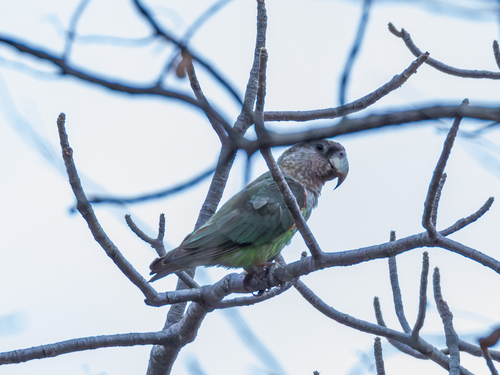
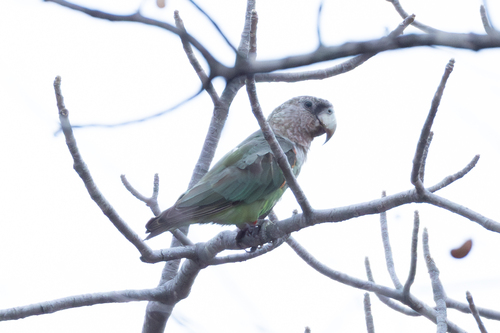
ID tip
The Cape parrot is a short-tailed moderately large bird with a very large beak used to crack all sorts of hard nuts and fruit kernels, especially those of African yellowwood trees (Podocarpus spp.). This contrasts with the closely related savanna species (Poicephalus fuscicollis) which feeds on a wide variety of tropical woodland trees such as marula, Commiphora spp. and Terminalia spp. These species are sexually dimorphic, with females typically sporting an orange frontal patch on the forehead.
Text from Wikipedia, licensed CC BY-SA 4.0.
When to see the Cape Parrot
One bar for each month, and every month is filled: this bird is recorded here in all twelve. The wide bar is December, the month with the most records.
Where to see the Cape Parrot
The map shades 17 countries with regular records. Everything unshaded has no records. Countries are listed below the map.
About the Cape Parrot
The Cape parrot or Levaillant's parrot is a large, temperate forest dwelling parrot of the genus Poicephalus endemic to South Africa. It was formerly grouped as a subspecies along with the savanna-dwelling brown-necked parrot and grey-headed parrot, but is now considered a distinct species.
Text adapted from Wikipedia, licensed CC BY-SA 4.0.
Easily confused with
 Red-bellied ParrotPoicephalus rufiventrisThe red-bellied parrot is a small parrot about 23 cm (9 in) long and weights 140 g (5 oz).
 Red-fronted ParrotPoicephalus gulielmiThe red-fronted parrot is 28 cm (11 in) long.
 Rüppell's ParrotPoicephalus rueppelliiRüppell's parrot is 22–25 cm (8.7–9.8 in) long and weighs 121–156 g (4.3–5.5 oz).
Side by side: Brown-headed Parrot vs Cape Parrot · Cape Parrot vs Senegal Parrot · Cape Parrot vs Red-fan Parrot · Cape Parrot vs Yellow-eared Parrot · Cape Parrot vs Red-bellied Parrot
Learn the Cape Parrot in the BeakBrain App
Photo and call practice. Coming soon to iPhone and Android.
Play today's Daily BirdEvery photo and recording on this page is credited to its author under the licence shown. Spotted a problem with this page, or have a better photo? Contribute.