Learn what every symbol on the card means.Full credits and sources at beakbrain.com/symbols
 WetlandCup nestTiny · 12 g


What the Sedge Warbler sounds like


ID tip
This is a medium-sized warbler, 11.5–13 cm (4.5–5.1 in) long and weighing around 12 g (0.42 oz). It has a streaked brown back and wings, and pale underparts. The rump is warm brown and unstreaked, contrasting with the duller wings. The forehead is flattened, the crown is streaked with black, and the bill is strong and pointed. There is a prominent whitish supercilium. The legs are greyish. The plumage of the sexes is identical, although they can be told apart when caught for ringing by the presence of a brood patch or cloacal protuberance. Juvenile birds have dark spots on the breast.
Text from Wikipedia, licensed CC BY-SA 4.0.
When to see the Sedge Warbler
One bar for each month. Filled bars are the 6 months with records; pale bars are months with none. The wide bar is August, the month with the most records.
Where to see the Sedge Warbler
The map shades 106 countries with regular records, and 7 more in a lighter tone where the bird turns up only as a stray. Everything unshaded has no records. Countries are listed below the map.
Recorded as a rare visitor in India, Iceland, São Tomé & Príncipe, United States, Burundi, Djibouti, Andorra.
About the Sedge Warbler
The sedge warbler is an Old World warbler in the genus Acrocephalus. It is a medium-sized warbler with a brown, streaked back and wings and a distinct pale supercilium. Sedge warblers are migratory, crossing the Sahara to get from their European and Asian breeding grounds to spend winter in Africa. The male's song is composed of random chattering phrases and can include mimicry of other species. The sedge warbler is mostly insectivorous.
Text adapted from Wikipedia, licensed CC BY-SA 4.0.
Easily confused with
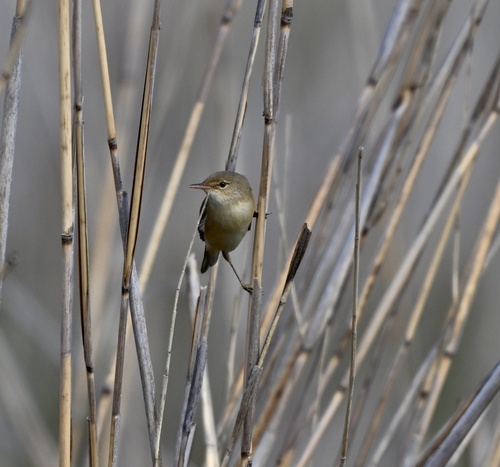 Common Reed WarblerAcrocephalus scirpaceusThis is a medium-sized warbler, 13 cm (5.1 in) in length with a wing-span of 17–21 cm (6.7–8.3 in).
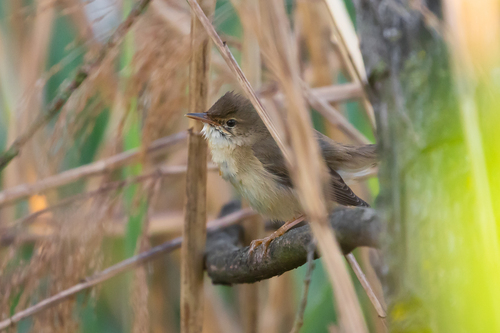 Marsh WarblerAcrocephalus palustrisThis is a medium-sized warbler.
 Blyth's Reed WarblerAcrocephalus dumetorumBlyth's reed warbler is between 12 and 14 cm (4.7 and 5.5 in) in length and weighs between 8 and 16 g (0.28 and 0.56 oz).
Side by side: Common Reed Warbler vs Sedge Warbler · Marsh Warbler vs Sedge Warbler · Blyth's Reed Warbler vs Sedge Warbler
Learn the Sedge Warbler in the BeakBrain App
Photo and call practice. Coming soon to iPhone and Android.
Play today's Daily BirdEvery photo and recording on this page is credited to its author under the licence shown. Spotted a problem with this page, or have a better photo? Contribute.