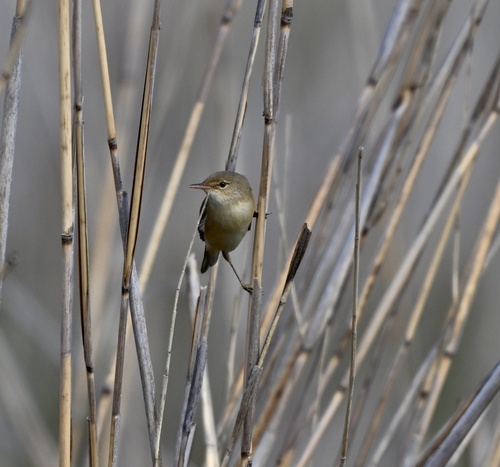
Common Reed Warbler
Acrocephalus scirpaceus
This is a medium-sized warbler, 13 cm (5.1 in) in length with a wing-span of 17–21 cm (6.7–8.3 in). The adult has an unstreaked brown back and buff underparts. The forehead is flattened, and the bill is strong and pointed. The sexes are identical, as with most warblers, but young birds are richer buff below. The common reed warbler looks similar to the great reed warbler, but the great reed warbler is larger in size and has a stronger supercilium. The song is a slow, chattering jit-jit-jit with typically acrocephaline whistles and mimicry added.
ID text from Wikipedia, CC BY-SA 4.0


Sedge Warbler
Acrocephalus schoenobaenus
This is a medium-sized warbler, 11.5–13 cm (4.5–5.1 in) long and weighing around 12 g (0.42 oz). It has a streaked brown back and wings, and pale underparts. The rump is warm brown and unstreaked, contrasting with the duller wings. The forehead is flattened, the crown is streaked with black, and the bill is strong and pointed. There is a prominent whitish supercilium. The legs are greyish. The plumage of the sexes is identical, although they can be told apart when caught for ringing by the presence of a brood patch or cloacal protuberance. Juvenile birds have dark spots on the breast.
ID text from Wikipedia, CC BY-SA 4.0

Where you might meet both
And 78 more countries.
Learn this pair in the BeakBrain App
Photo and call practice. Coming soon to iPhone and Android.
Play today's Daily BirdPhotos and recordings are credited to their authors under the licence shown. Full profiles: Common Reed Warbler and Sedge Warbler.