Learn what every symbol on the card means.Full credits and sources at beakbrain.com/symbols
 CoastalScrapeSmall · 52 g


What the Sanderling sounds like


ID tip
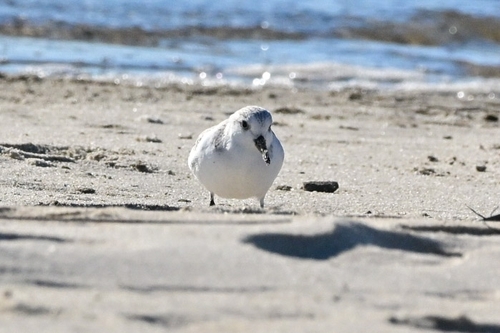
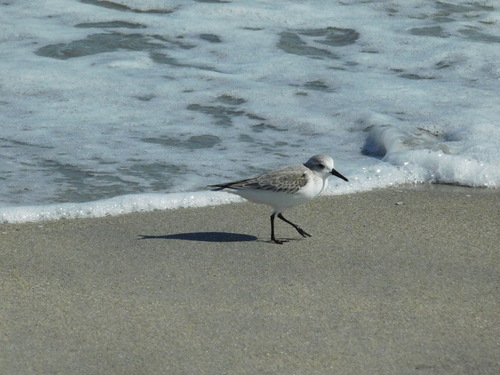
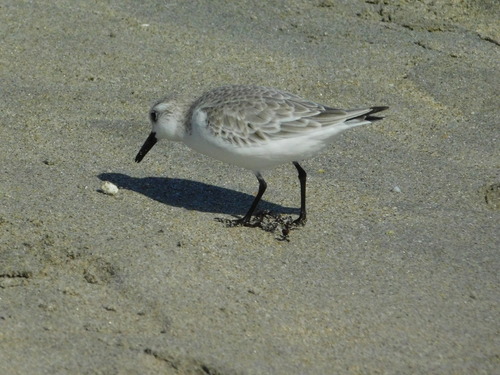
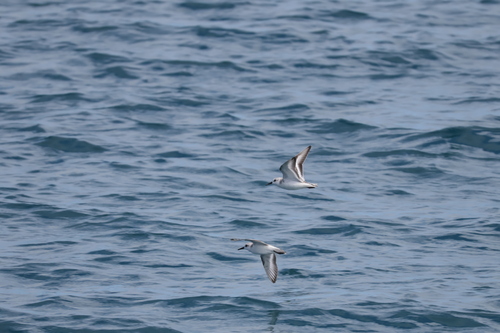
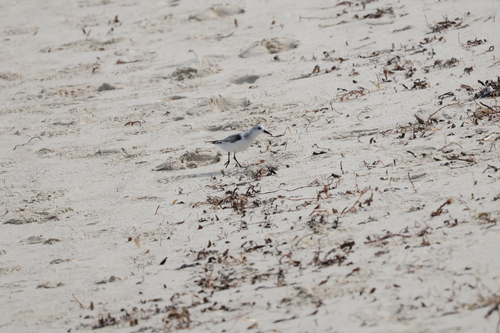
The sanderling is a small plump sandpiper, 18–20 cm (7–8 in) in length. Its weight ranges from 40–100 g (1+1⁄2–3+1⁄2 oz). The winter bird is very pale, almost white apart from a dark shoulder patch. This is the source of the specific name, alba, which is the Latin for "white". Later in the summer, the face and throat become brick-red. The juvenile bird is spangled black and white, and shows much more contrast than the adult.
Text from Wikipedia, licensed CC BY-SA 4.0.
When to see the Sanderling
One bar for each month. Filled bars are the 11 months with records; pale bars are months with none. The wide bar is September, the month with the most records.
Where to see the Sanderling
The map shades 189 countries with regular records, and 7 more in a lighter tone where the bird turns up only as a stray. Everything unshaded has no records. Countries are listed below the map.
Recorded as a rare visitor in Kyrgyzstan, Uzbekistan, Kiribati, Comoros, Ethiopia, Iraq, Niue.
About the Sanderling
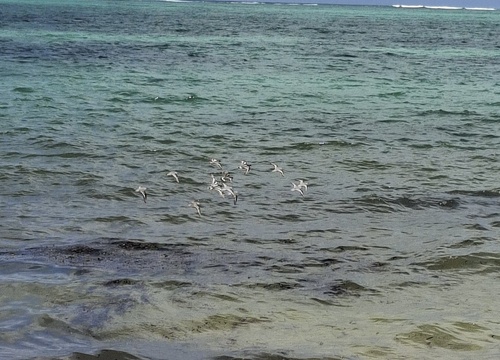
The sanderling is a small wading bird. It is a circumpolar Arctic breeder, being among the most extreme northern breeding birds in the world, nesting only on the coldest tundra, north of the 5°C July isotherm; in Europe, its southernmost breeding locality is Svalbard, where only a handful (5–15) pairs breed. It is a long-distance migrant, wintering south to South America, western and southern Europe, Africa, and Australia. It is highly gregarious in winter, sometimes forming large flocks on coastal mudflats or sandy beaches.
Text adapted from Wikipedia, licensed CC BY-SA 4.0.
Easily confused with
 Semipalmated SandpiperCalidris pusillaIt is a small sandpiper, 15–18 centimetres (6–7 inches) long and weighing around 18–51.5 grams (0.63–1.82 ounces).
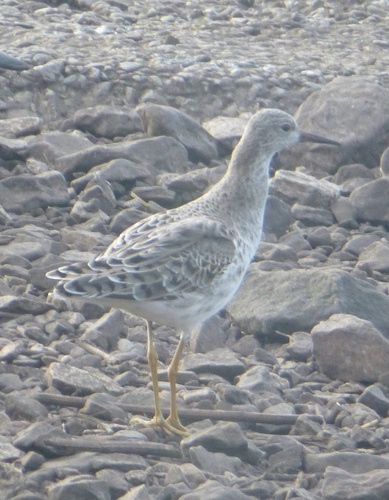 RuffCalidris pugnaxThe ruff has a distinctive pot-bellied appearance, with a small head, medium-length bill, longish neck and heavy body.
 Least SandpiperCalidris minutillaThis species has yellow-green legs and a short, thin, dark bill.
Side by side: Dunlin vs Sanderling · Least Sandpiper vs Sanderling · Sanderling vs Semipalmated Sandpiper · Ruff vs Sanderling
Learn the Sanderling in the BeakBrain App
Photo and call practice. Coming soon to iPhone and Android.
Play today's Daily BirdEvery photo and recording on this page is credited to its author under the licence shown. Spotted a problem with this page, or have a better photo? Contribute.