Learn what every symbol on the card means.Full credits and sources at beakbrain.com/symbols
 MarinePlatform nestMedium · 198 g




What the Sabine's Gull sounds like

ID tip
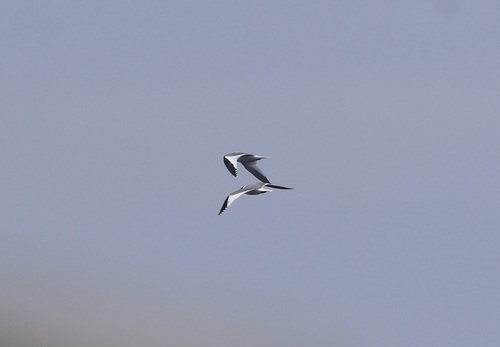
Sabine's gull is a small gull, 27 to 33 cm (10+1⁄2–13 in) in length and weighing 135 to 225 g (4+3⁄4–8 oz). The wings are long, thin and pointed with a span of between 81 and 87 cm (32–34+1⁄2 in). The bill, which is black with a yellow tip, is around 2.5 cm (1 in) long. This species is easy to identify through its striking wing pattern, though at long range it can be confused with immature black-legged kittiwakes. The adult has a pale grey back and wing coverts, four black outer primary flight feathers, and white inner primaries and secondaries. The white tail is slightly forked.
Text from Wikipedia, licensed CC BY-SA 4.0.
When to see the Sabine's Gull
One bar for each month. Filled bars are the 7 months with records; pale bars are months with none. The wide bar is September, the month with the most records.
Where to see the Sabine's Gull
The map shades 48 countries with regular records, and 16 more in a lighter tone where the bird turns up only as a stray. Everything unshaded has no records. Countries are listed below the map.
Recorded as a rare visitor in Netherlands, Australia, Finland, Taiwan, Morocco, China, United Arab Emirates, Gabon, São Tomé & Príncipe, Bermuda, Cuba, French Guiana, Estonia, Indonesia, Oman, Gibraltar.
About the Sabine's Gull
Sabine's gull is a small gull. It is usually treated as the only species placed in the genus Xema, though some authors include it with other gulls in a wide view of the genus Larus. It has also been known historically as fork-tailed gull or xeme. It breeds in colonies on Arctic coasts and tundra, laying two or three spotted olive-brown eggs in a ground nest lined with grass. Sabine's gull is pelagic outside the breeding season. It takes a wide variety of mainly animal food, and will eat any suitable small prey.
Text adapted from Wikipedia, licensed CC BY-SA 4.0.
Easily confused with
 Grey-headed GullChroicocephalus cirrocephalusThe grey-headed gull is slightly larger than the black-headed gull at 42 cm length.
 River TernSterna aurantiaIt is a medium-large tern, 38–46 cm long with an 80–85 cm wingspan, distinctly larger than any other species in Sterna and more comparable in size to a Sandwich tern (Thalasseus sandvicensis) or a lesser crested tern (T. bengalensis).
 Slender-billed GullChroicocephalus geneiThis species is 37 to 40 cm (14.6 to 15.7 in) long with a 90 to 102 cm (35.4 to 40.2 in) wingspan.
Side by side: Grey-headed Gull vs Sabine's Gull · Sabine's Gull vs Slender-billed Gull · River Tern vs Sabine's Gull
Learn the Sabine's Gull in the BeakBrain App
Photo and call practice. Coming soon to iPhone and Android.
Play today's Daily BirdEvery photo and recording on this page is credited to its author under the licence shown. Spotted a problem with this page, or have a better photo? Contribute.