Learn what every symbol on the card means.Full credits and sources at beakbrain.com/symbols
 GrasslandCup nestSmall · 26 g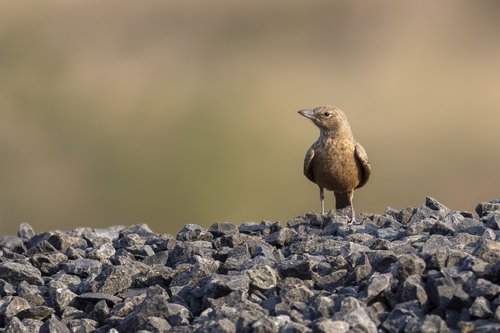


ID tip
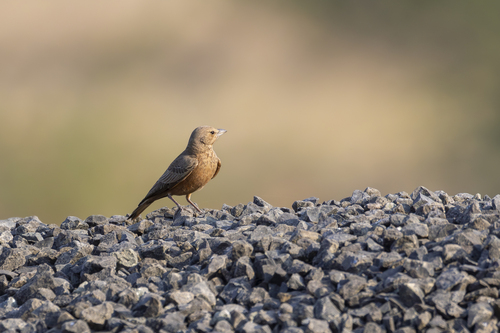
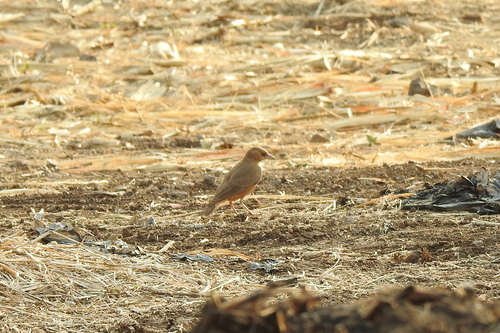
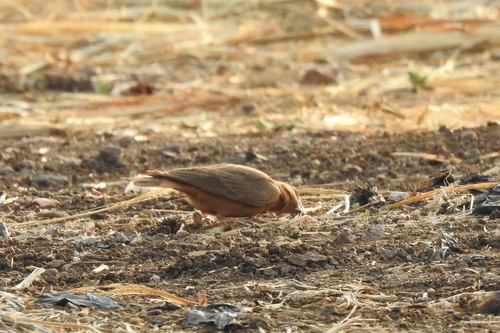
Like other Ammomanes larks, the species has a wide curved beak with the nostrils covered by feathers. The hindclaw is as long as the hindtoe and moderately curved. The base of the lower mandible is fleshy while the rest is horn-grey. The legs are also flesh coloured. In the field, the rufous colour, the reddish rump and a dark tail band (narrowing towards the sides to give a triangular shape) are distinctive. The throat is lightly streaked in dark brown. Young birds have less streaking on the underside.
Text from Wikipedia, licensed CC BY-SA 4.0.
When to see the Rufous-tailed Lark
One bar for each month. Filled bars are the 10 months with records; pale bars are months with none. The wide bar is February, the month with the most records.
Where to see the Rufous-tailed Lark
The map shades 2 countries with regular records. Everything unshaded has no records. Countries are listed below the map.
About the Rufous-tailed Lark
The rufous-tailed lark, also sometimes called the rufous-tailed finch-lark, is a ground bird found in the drier open stony habitats of India and parts of Pakistan. Like other species in the genus it has a large finch-like bill with a slightly curved edge to the upper mandible. The dull brown colour matches the soil as it forages for grass seeds, grain and insects. Males and females are indistinguishable in the field but during the breeding season, the male has a courtship display that involves flying up steeply and then nose-diving and pulling up in a series of stepped wavy dips accompanied by calling. They forage on the ground in pairs or small groups.
Text adapted from Wikipedia, licensed CC BY-SA 4.0.
Easily confused with
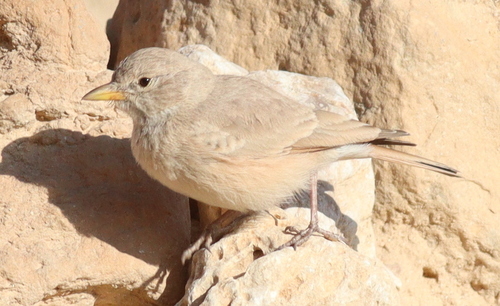 Desert LarkAmmomanes desertiThe desert lark is a medium-sized, big-headed and long-billed lark, growing to a length of 16 to 17 cm (6.3 to 6.7 in).
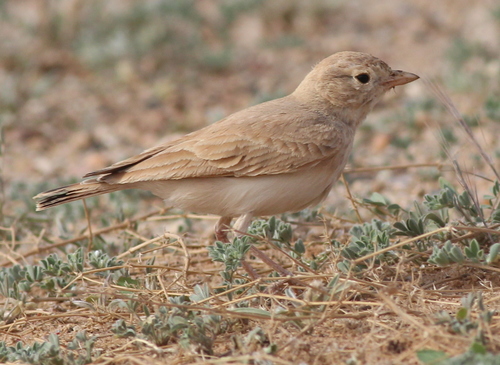 Bar-tailed LarkAmmomanes cincturaThe bar-tailed lark is similar to the desert lark in appearance, but at 14 to 15 cm (5.5 to 5.9 in), is slightly smaller, with a smaller, more domed head, a smaller beak, thinner legs and a shorter tail.
Side by side: Desert Lark vs Rufous-tailed Lark · Bar-tailed Lark vs Rufous-tailed Lark
Learn the Rufous-tailed Lark in the BeakBrain App
Photo and call practice. Coming soon to iPhone and Android.
Play today's Daily BirdEvery photo and recording on this page is credited to its author under the licence shown. Spotted a problem with this page, or have a better photo? Contribute.