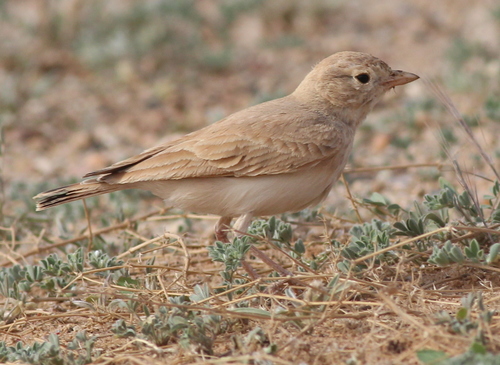
Bar-tailed Lark
Ammomanes cinctura
The bar-tailed lark is similar to the desert lark in appearance, but at 14 to 15 cm (5.5 to 5.9 in), is slightly smaller, with a smaller, more domed head, a smaller beak, thinner legs and a shorter tail. The upper parts are sandy-buff washed with grey, while the underparts are whitish with little if any streaking, and the breast and flanks washed with buff. The rufous wings have dark trailing edges and the rufous tail has a terminal black band.
ID text from Wikipedia, CC BY-SA 4.0
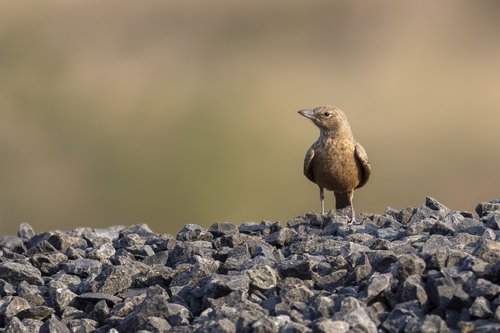
Rufous-tailed Lark
Ammomanes phoenicura
Like other Ammomanes larks, the species has a wide curved beak with the nostrils covered by feathers. The hindclaw is as long as the hindtoe and moderately curved. The base of the lower mandible is fleshy while the rest is horn-grey. The legs are also flesh coloured. In the field, the rufous colour, the reddish rump and a dark tail band (narrowing towards the sides to give a triangular shape) are distinctive. The throat is lightly streaked in dark brown. Young birds have less streaking on the underside.
ID text from Wikipedia, CC BY-SA 4.0
Learn this pair in the BeakBrain App
Photo and call practice. Coming soon to iPhone and Android.
Play today's Daily BirdPhotos and recordings are credited to their authors under the licence shown. Full profiles: Bar-tailed Lark and Rufous-tailed Lark.