Learn what every symbol on the card means.Full credits and sources at beakbrain.com/symbols
 DesertCup nestSmall · 24 g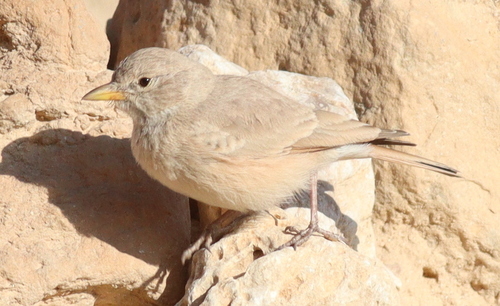


ID tip
The desert lark is a medium-sized, big-headed and long-billed lark, growing to a length of 16 to 17 cm (6.3 to 6.7 in). The sexes are alike, but there is considerable geographical variation. It has a rather dull plumage which can vary from quite pale to rather dark. Plumage may vary between subspecies but individuals within populations can be variable too. It is similar in appearance to the bar-tailed lark but is slightly larger, has a less-domed head, a larger broader beak, stouter legs and a longer tail.
Text from Wikipedia, licensed CC BY-SA 4.0.
When to see the Desert Lark
One bar for each month. Filled bars are the 9 months with records; pale bars are months with none. The wide bar is March, the month with the most records.
Where to see the Desert Lark
The map shades 31 countries with regular records, and 2 more in a lighter tone where the bird turns up only as a stray. Everything unshaded has no records. Countries are listed below the map.
Recorded as a rare visitor in Afghanistan, Eritrea.
About the Desert Lark
The desert lark breeds in deserts and semi-deserts from Morocco to western India. It has a very wide distribution and faces no obvious threats, and surveys have shown that it is slowly increasing in numbers as it expands its range. The International Union for Conservation of Nature has rated its conservation status as being of "least concern".
Text adapted from Wikipedia, licensed CC BY-SA 4.0.
Easily confused with
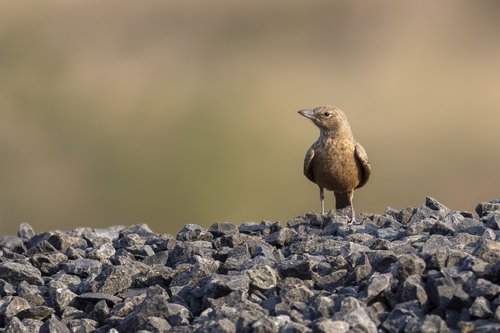 Rufous-tailed LarkAmmomanes phoenicuraLike other Ammomanes larks, the species has a wide curved beak with the nostrils covered by feathers.
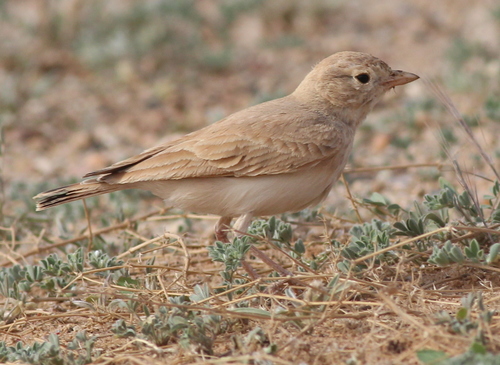 Bar-tailed LarkAmmomanes cincturaThe bar-tailed lark is similar to the desert lark in appearance, but at 14 to 15 cm (5.5 to 5.9 in), is slightly smaller, with a smaller, more domed head, a smaller beak, thinner legs and a shorter tail.
Side by side: Desert Lark vs Rufous-tailed Lark · Bar-tailed Lark vs Desert Lark
Learn the Desert Lark in the BeakBrain App
Photo and call practice. Coming soon to iPhone and Android.
Play today's Daily BirdEvery photo and recording on this page is credited to its author under the licence shown. Spotted a problem with this page, or have a better photo? Contribute.