Learn what every symbol on the card means.Full credits and sources at beakbrain.com/symbols
 ShrublandPlatform nestLarge · 531 g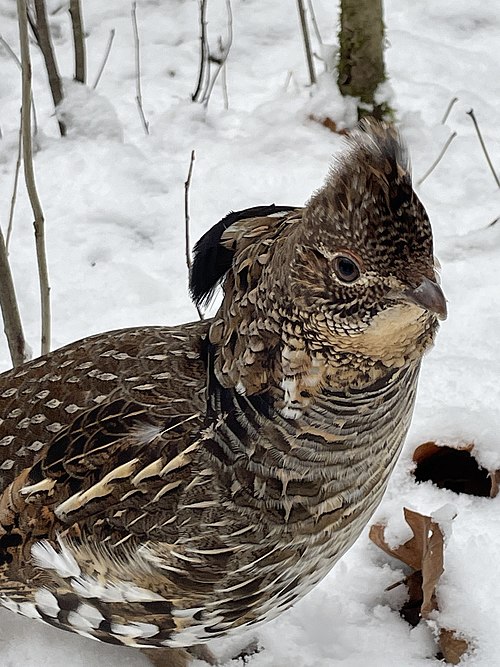

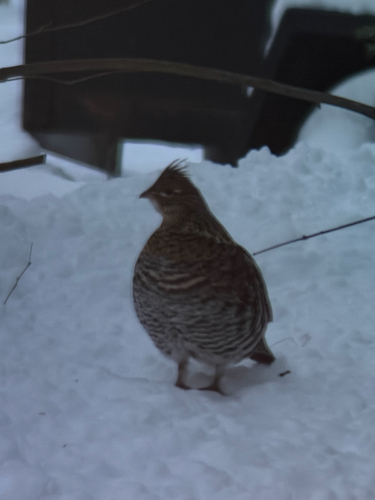
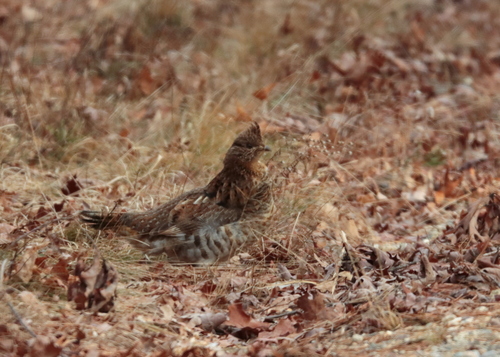
What the Ruffed Grouse sounds like


ID tip
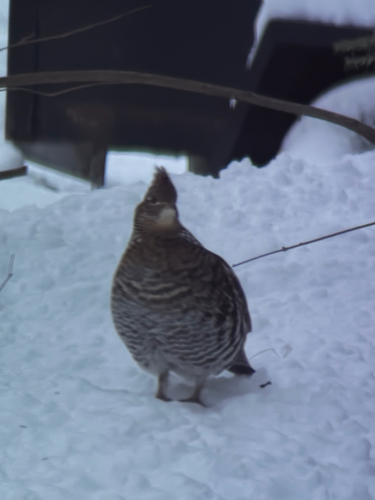
Ruffed grouse are chunky, medium-sized birds that weigh from 450–750 g (0.99–1.65 lb), measure from 40 to 50 cm (16 to 20 in) in length, and span 50–64 cm (20–25 in) across their short, strong wings. They have two distinct morphs - grey and brown. In the grey morph, the head, neck, and back are grey-brown; the breast is light with barring, with as much white on the underside and flanks. Overall, the birds have a variegated appearance; the throat is often distinctly lighter. The tail is essentially the same brownish grey, with regular barring and a broad black band near the end ("subterminal").
Text from Wikipedia, licensed CC BY-SA 4.0.
When to see the Ruffed Grouse
One bar for each month. Filled bars are the 11 months with records; pale bars are months with none. The wide bar is May, the month with the most records.
Where to see the Ruffed Grouse
The map shades 2 countries with regular records, and 1 more in a lighter tone where the bird turns up only as a stray. Everything unshaded has no records. Countries are listed below the map.
Recorded as a rare visitor in St. Pierre & Miquelon.
About the Ruffed Grouse
The ruffed grouse is a medium-sized grouse occurring in forests from the Appalachian Mountains across Canada to Alaska. It is the most widely distributed game bird in North America. It is not migratory. It is the only species in the genus Bonasa. The ruffed grouse is sometimes incorrectly referred to as a "partridge", an unrelated phasianid, and occasionally confused with the grey partridge, a bird of open areas rather than woodlands.
Text adapted from Wikipedia, licensed CC BY-SA 4.0.
Easily confused with
 Indian PeafowlPavo cristatusThe Indian peafowl's size, color and shape of the crest make them easily identifiable within their native distribution range.
 Grey PartridgePerdix perdixThe grey partridge is a rotund bird, brown-backed, with grey flanks and chest.
 Grey FrancolinOrtygornis pondicerianusThis bird is a medium-sized francolin, with males averaging 11.6–13.4 in (29–34 cm) and females averaging 10.2–11.9 in (26–30 cm).
Side by side: Indian Peafowl vs Ruffed Grouse · Grey Partridge vs Ruffed Grouse · Grey Francolin vs Ruffed Grouse
Learn the Ruffed Grouse in the BeakBrain App
Photo and call practice. Coming soon to iPhone and Android.
Play today's Daily BirdEvery photo and recording on this page is credited to its author under the licence shown. Spotted a problem with this page, or have a better photo? Contribute.