Learn what every symbol on the card means.Full credits and sources at beakbrain.com/symbols
 ForestScrapeHuge · 4.2 kg


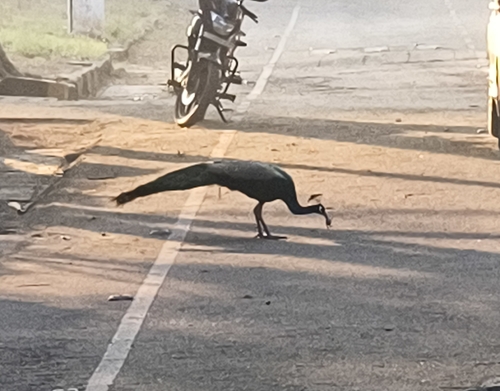
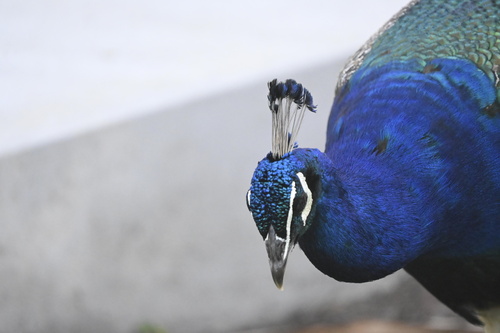
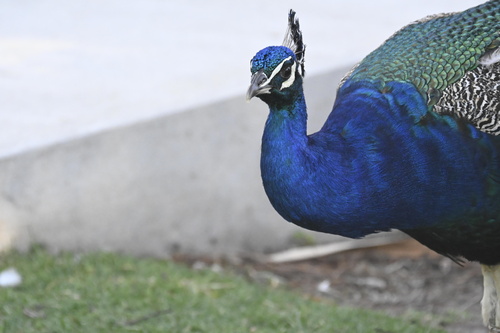
What the Indian Peafowl sounds like


ID tip
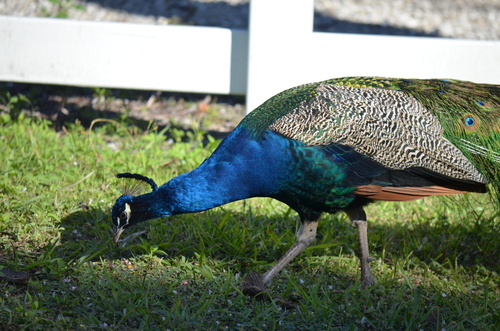
The Indian peafowl's size, color and shape of the crest make them easily identifiable within their native distribution range. It displays a marked form of sexual dimorphism. A male peafowl or peacock is a larger sized bird with an average bill to tail length of 100–120 cm (40–46 in) and as much as 200–230 cm (78–90 in) to the end of a fully grown train. It weighs 4.1–5.2 kg (9–11.5 lb) and is amongst the heaviest birds in Phasianidae. The male has a metallic blue crown with short and curled, blue-greenish head feathers.
Text from Wikipedia, licensed CC BY-SA 4.0.
When to see the Indian Peafowl
One bar for each month, and every month is filled: this bird is recorded here in all twelve. The wide bar is February, the month with the most records.
Where to see the Indian Peafowl
The map shades 61 countries with regular records, and 24 more in a lighter tone where the bird turns up only as a stray. Everything unshaded has no records. Countries are listed below the map.
Recorded as a rare visitor in Belgium, Netherlands, Argentina, Costa Rica, Morocco, Switzerland, Norway, Serbia, Chile, Honduras, South Korea, Türkiye, Mozambique, Guatemala, Peru, Malaysia, North Macedonia, Russia, Sweden, Slovakia, Angola, Rwanda, St. Barthélemy, Lithuania.
About the Indian Peafowl
The Indian peafowl, also known as the common peafowl, or blue peafowl, is a species of peafowl native to the Indian subcontinent. While it originated in the Indian subcontinent, it has since been introduced to many other parts of the world. Male peafowl are referred to as peacocks, and female peafowl are referred to as peahens, although both sexes are often referred to colloquially as a "peacock".
Text adapted from Wikipedia, licensed CC BY-SA 4.0.
Easily confused with

Side by side: Indian Peafowl vs Ruffed Grouse · Green Peafowl vs Indian Peafowl
Learn the Indian Peafowl in the BeakBrain App
Photo and call practice. Coming soon to iPhone and Android.
Play today's Daily BirdEvery photo and recording on this page is credited to its author under the licence shown. Spotted a problem with this page, or have a better photo? Contribute.