Learn what every symbol on the card means.Full credits and sources at beakbrain.com/symbols
 ShrublandCavity nestSmall · 54 g


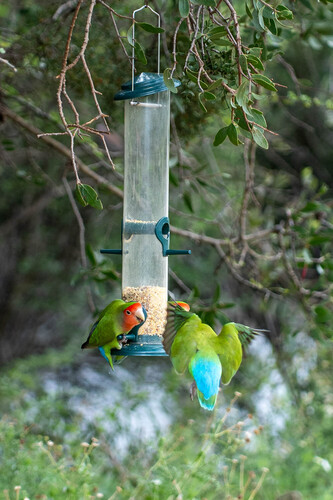
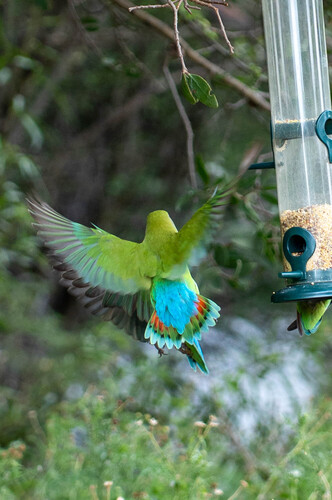


ID tip
The rosy-faced lovebird is a fairly small bird, 17–18 cm (6.7–7.1 in) long, with an average wing length of 106 mm (4.2 in) and tail length of 44–52 mm (1.7–2.0 in). Wild birds are mostly green with a blue rump. The face and throat are pink, darkest on the forehead and above the eye. The bill is horn-coloured, the iris is brown, and the legs and feet are grey. The pink of the A. r. roseicollis is lighter than that of the A. r. catumbella. Juvenile birds have a pale pink face and throat, a greenish fore crown and crown, and the beak has a brownish base.
Text from Wikipedia, licensed CC BY-SA 4.0.
When to see the Rosy-faced Lovebird
One bar for each month, and every month is filled: this bird is recorded here in all twelve. The wide bar is January, the month with the most records.
Where to see the Rosy-faced Lovebird
The map shades 23 countries with regular records, and 23 more in a lighter tone where the bird turns up only as a stray. Everything unshaded has no records. Countries are listed below the map.
Recorded as a rare visitor in France, Australia, Mexico, Belgium, Taiwan, Canada, Germany, Chile, Colombia, Hong Kong SAR China, Thailand, Botswana, Argentina, Brazil, Martinique, United Kingdom, Greece, Zimbabwe, Costa Rica, Venezuela, India, Oman, Czechia.
About the Rosy-faced Lovebird
The rosy-faced lovebird, also known as the rosy-collared or peach-faced lovebird, is a species of lovebird native to the Namibian savanna woodlands. Loud and constant chirpers, these birds are very social animals and often congregate in small groups in the wild. They eat throughout the day and take frequent baths. Coloration can vary widely among populations. Plumage is identical in males and females. Lovebirds are renowned for their sleep position in which they sit side-by-side and turn their faces in towards each other. Also, females are well noted to tear raw materials into long strips, "twisty-tie" them onto their backs, and fly substantial distances back to make a nest.
Text adapted from Wikipedia, licensed CC BY-SA 4.0.
Easily confused with
 Fischer's LovebirdAgapornis fischeriThe Fischer's lovebird has a green back, chest, and wings.
 Yellow-collared LovebirdAgapornis personatusThe yellow-collared lovebird is a mainly green small parrot about 14.5 cm (5.5 in) long.
 Grey-headed LovebirdAgapornis canusThe grey-headed lovebird is one of the smallest species of the lovebird genus, being 13 cm (5 inches) long and weighing about 30–36 grams.
Side by side: Budgerigar vs Rosy-faced Lovebird · Fischer's Lovebird vs Rosy-faced Lovebird · Rosy-faced Lovebird vs Yellow-collared Lovebird
Learn the Rosy-faced Lovebird in the BeakBrain App
Photo and call practice. Coming soon to iPhone and Android.
Play today's Daily BirdEvery photo and recording on this page is credited to its author under the licence shown. Spotted a problem with this page, or have a better photo? Contribute.