Learn what every symbol on the card means.Full credits and sources at beakbrain.com/symbols
 WoodlandCavity nestSmall · 48 g


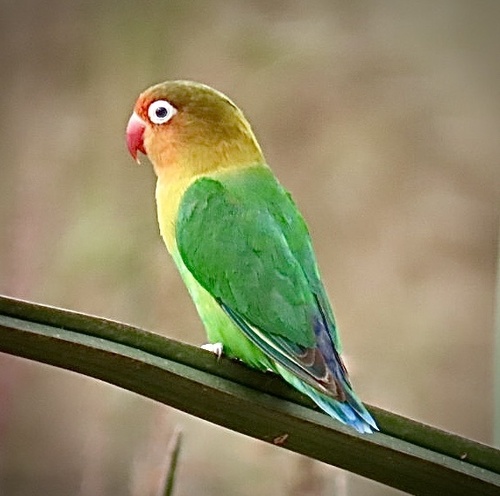
ID tip
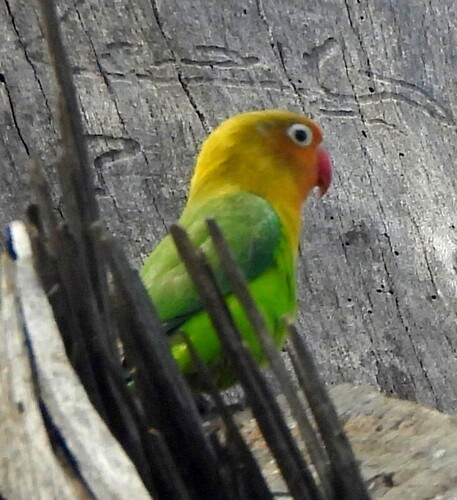
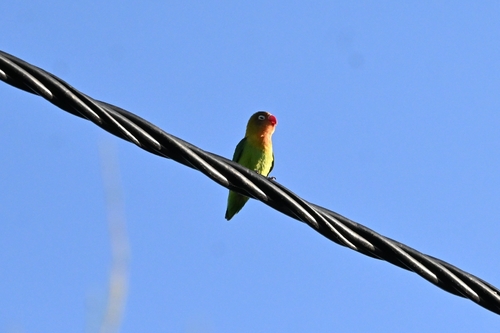
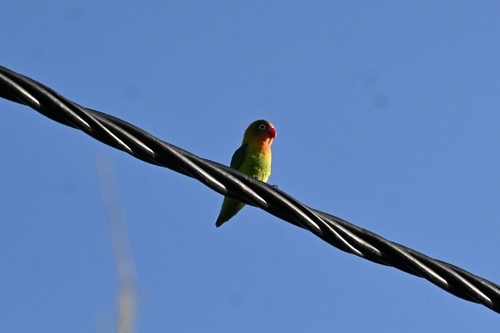
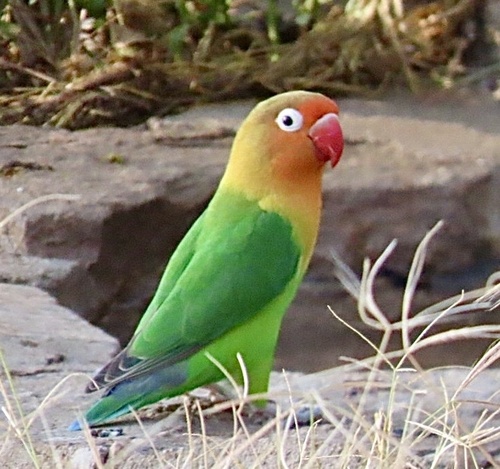
The Fischer's lovebird has a green back, chest, and wings. Their necks are a golden yellow and as it progresses upward it becomes darker orange. The top of the head is olive green, and the beak is bright red. The upper surface of the tail has some purple or blue feathers. It has a white circle of bare skin (eye-ring) around its eyes. Young birds are very similar to the adults, except for the fact that they are duller and the base of their mandible has brown markings. They are one of the smaller lovebirds, about 14 cm (5.5 in) in length and 43-58g weight.
Text from Wikipedia, licensed CC BY-SA 4.0.
When to see the Fischer's Lovebird
One bar for each month, and every month is filled: this bird is recorded here in all twelve. The wide bar is February, the month with the most records.
Where to see the Fischer's Lovebird
The map shades 14 countries with regular records, and 16 more in a lighter tone where the bird turns up only as a stray. Everything unshaded has no records. Countries are listed below the map.
Recorded as a rare visitor in United States, France, South Africa, Belgium, Germany, Thailand, China, Italy, Chile, Réunion, Colombia, Kuwait, Maldives, Philippines, Czechia, United Kingdom.
About the Fischer's Lovebird
Fischer's lovebird is a small parrot species of the genus Agapornis. They were originally discovered in the late 19th century. They are named after the 19th century German explorer of East Africa Gustav Fischer.
Text adapted from Wikipedia, licensed CC BY-SA 4.0.
Easily confused with
 Yellow-collared LovebirdAgapornis personatusThe yellow-collared lovebird is a mainly green small parrot about 14.5 cm (5.5 in) long.
 Grey-headed LovebirdAgapornis canusThe grey-headed lovebird is one of the smallest species of the lovebird genus, being 13 cm (5 inches) long and weighing about 30–36 grams.
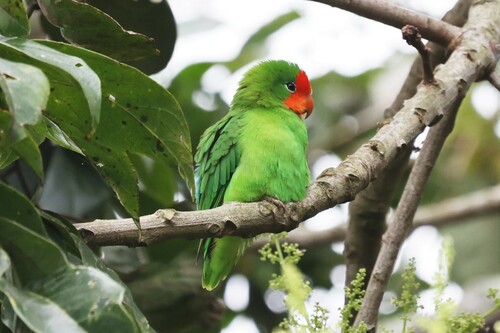 Red-headed LovebirdAgapornis pullariusThe red-headed lovebird is a 15 cm (6 inches) long, mostly green parrot.
Side by side: Fischer's Lovebird vs Rosy-faced Lovebird · Bourke's Parrot vs Fischer's Lovebird · Fischer's Lovebird vs Yellow-collared Lovebird
Learn the Fischer's Lovebird in the BeakBrain App
Photo and call practice. Coming soon to iPhone and Android.
Play today's Daily BirdEvery photo and recording on this page is credited to its author under the licence shown. Spotted a problem with this page, or have a better photo? Contribute.