Learn what every symbol on the card means.Full credits and sources at beakbrain.com/symbols
 RockyCavity nestSmall · 16 g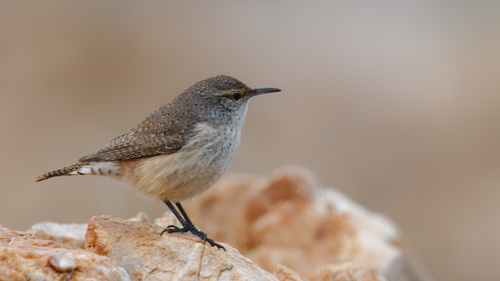



What the Rock Wren sounds like


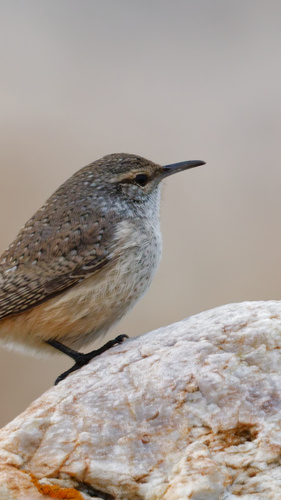
ID tip
The rock wren is between 12.5–15 cm (4.9–5.9 in) in length and has a wingspan of 22–24 cm (8.7–9.4 in). It has a bill length of 18.7 mm (0.74 in) in males and 17.8 mm (0.70 in) in females. Its wing length is 70.3 mm (2.77 in) in males, and slightly less at 67.8 mm (2.67 in) in females; similarly, its tail length is 51.9 mm (2.04 in) and 47.8 mm (1.88 in) in males and females, respectively. However, males weigh 15.7 g (0.55 oz), slightly less than females, who weigh 17.2 g (0.61 oz). Voice: Female rock wrens do not sing; however, males have large repertoires of 69–119 syllables, each song a 1–2.5 second trill of repeated syllables, with 3–5 seconds between songs.
Text from Wikipedia, licensed CC BY-SA 4.0.
When to see the Rock Wren
One bar for each month, and every month is filled: this bird is recorded here in all twelve. The wide bar is May, the month with the most records.
Where to see the Rock Wren
The map shades 7 countries with regular records, and 1 more in a lighter tone where the bird turns up only as a stray. Everything unshaded has no records. Countries are listed below the map.
Recorded as a rare visitor in Costa Rica.
About the Rock Wren
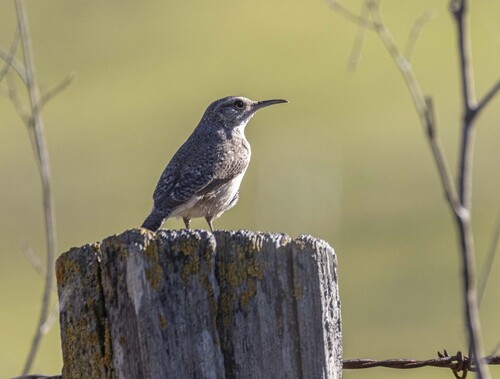
The rock wren is a small songbird of the wren family native to the rocky areas of western North America. There are 8 subspecies of the rock wren, one of which is extinct. They are similar in size to other wrens, with a grey-brown coat, a brown rump, and a speckled white throat.
Text adapted from Wikipedia, licensed CC BY-SA 4.0.
Easily confused with
 Cactus WrenCampylorhynchus brunneicapillusThe cactus wren is the largest wren in the United States.
 Canyon WrenCatherpes mexicanusThe canyon wren measures 14–15 cm (5.5–5.9 in) with a long thin beak and square-tipped tail.
 Grass WrenCistothorus platensisThe grass wren is 10 to 10.5 cm (3.9 to 4.1 in) long.
Side by side: Cactus Wren vs Rock Wren · Canyon Wren vs Rock Wren · Grass Wren vs Rock Wren
Learn the Rock Wren in the BeakBrain App
Photo and call practice. Coming soon to iPhone and Android.
Play today's Daily BirdEvery photo and recording on this page is credited to its author under the licence shown. Spotted a problem with this page, or have a better photo? Contribute.