
Cactus Wren
Campylorhynchus brunneicapillus
The cactus wren is the largest wren in the United States. It is between 18 and 19 cm (7.1 and 7.5 in) long, and weighs between 33.4 and 46.9 g (1.18 and 1.65 oz), with an average of 38.9 g (1.37 oz). It has a thick, heavy bill that is dull black, curves slightly downwards, and is about the same length as the head. The lower mandible is grayish and pale, and the tail is long and rounded. The cactus wren's coloration is brown with white speckles. The crown is chocolate-brown with a light red tinge. Voice: The main call of the cactus wren is a harsh and raspy series of jar-jar-jar, or char, notes, which increase in volume and pitch as the song goes on. Each part of the call lasts around four seconds, with four to eight seconds between calls; calls can carry up to 300 metres (1,000 ft). Cornell University ornithologists described it as sounding "like a car that just won't start".
ID text from Wikipedia, CC BY-SA 4.0
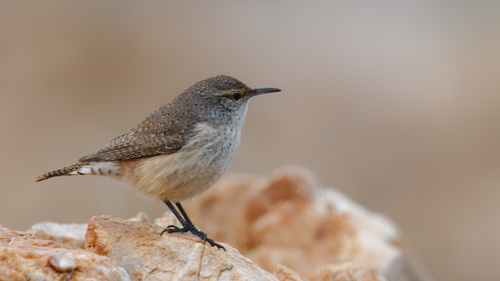
Rock Wren
Salpinctes obsoletus
The rock wren is between 12.5–15 cm (4.9–5.9 in) in length and has a wingspan of 22–24 cm (8.7–9.4 in). It has a bill length of 18.7 mm (0.74 in) in males and 17.8 mm (0.70 in) in females. Its wing length is 70.3 mm (2.77 in) in males, and slightly less at 67.8 mm (2.67 in) in females; similarly, its tail length is 51.9 mm (2.04 in) and 47.8 mm (1.88 in) in males and females, respectively. However, males weigh 15.7 g (0.55 oz), slightly less than females, who weigh 17.2 g (0.61 oz). Voice: Female rock wrens do not sing; however, males have large repertoires of 69–119 syllables, each song a 1–2.5 second trill of repeated syllables, with 3–5 seconds between songs.
ID text from Wikipedia, CC BY-SA 4.0

Where you might meet both
Learn this pair in the BeakBrain App
Photo and call practice. Coming soon to iPhone and Android.
Play today's Daily BirdPhotos and recordings are credited to their authors under the licence shown. Full profiles: Cactus Wren and Rock Wren.