
Canyon Wren
Catherpes mexicanus
The canyon wren measures 14–15 cm (5.5–5.9 in) with a long thin beak and square-tipped tail. Its speckled, chestnut coloration shades to gray at the head with a contrasting white throat patch. Its coloration and small size allow it to camouflage seamlessly with its rocky environment. The canyon wren's loud, distinctive call consists of a series of cascading notes. It sings most frequently in spring, however mated pairs may sing at any time. When defending its territory, the song is harsher and has a lower frequency,
ID text from Wikipedia, CC BY-SA 4.0

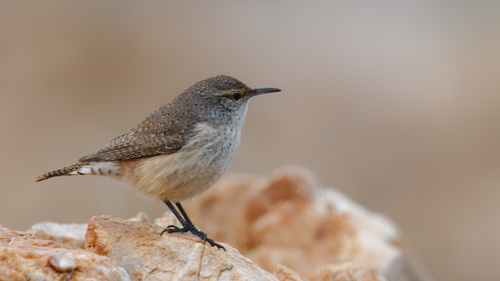
Rock Wren
Salpinctes obsoletus
The rock wren is between 12.5–15 cm (4.9–5.9 in) in length and has a wingspan of 22–24 cm (8.7–9.4 in). It has a bill length of 18.7 mm (0.74 in) in males and 17.8 mm (0.70 in) in females. Its wing length is 70.3 mm (2.77 in) in males, and slightly less at 67.8 mm (2.67 in) in females; similarly, its tail length is 51.9 mm (2.04 in) and 47.8 mm (1.88 in) in males and females, respectively. However, males weigh 15.7 g (0.55 oz), slightly less than females, who weigh 17.2 g (0.61 oz). Voice: Female rock wrens do not sing; however, males have large repertoires of 69–119 syllables, each song a 1–2.5 second trill of repeated syllables, with 3–5 seconds between songs.
ID text from Wikipedia, CC BY-SA 4.0

Where you might meet both
Learn this pair in the BeakBrain App
Photo and call practice. Coming soon to iPhone and Android.
Play today's Daily BirdPhotos and recordings are credited to their authors under the licence shown. Full profiles: Canyon Wren and Rock Wren.