Learn what every symbol on the card means.Full credits and sources at beakbrain.com/symbols
 ForestCup nestSmall · 38 g


What the Red Crossbill sounds like


ID tip
Crossbills are characterized by the mandibles crossing at their tips, which gives the group its English name. Using their crossed mandibles for leverage, crossbills are able to efficiently separate the scales of conifer cones and extract the seeds on which they feed. Adult males tend to be red or orange in colour, and females green or yellow, but there is much variation. The distinctive crossed mandibles eliminate most other species, but this feature is shared by the similar two-barred crossbill, with which it overlaps considerably in range.
Text from Wikipedia, licensed CC BY-SA 4.0.
When to see the Red Crossbill
One bar for each month, and every month is filled: this bird is recorded here in all twelve. The wide bar is June, the month with the most records.
Where to see the Red Crossbill
The map shades 75 countries with regular records, and 4 more in a lighter tone where the bird turns up only as a stray. Everything unshaded has no records. Countries are listed below the map.
Recorded as a rare visitor in Taiwan, Azerbaijan, Pakistan, Jersey.
About the Red Crossbill
The red crossbill or common crossbill is a small passerine bird in the finch family Fringillidae. Crossbills have distinctive mandibles, crossed at the tips, which enable them to extract seeds from conifer cones and other fruits.
Text adapted from Wikipedia, licensed CC BY-SA 4.0.
Easily confused with
 Two-barred CrossbillLoxia leucopteraThe two-barred crossbill is 14.5–17 cm (5.7–6.7 in) in length and weighs 25–40 g (0.88–1.41 oz).
 Parrot CrossbillLoxia pytyopsittacusAdult males tend to be red or orange in colour, and females green or yellow, but there is much variation.
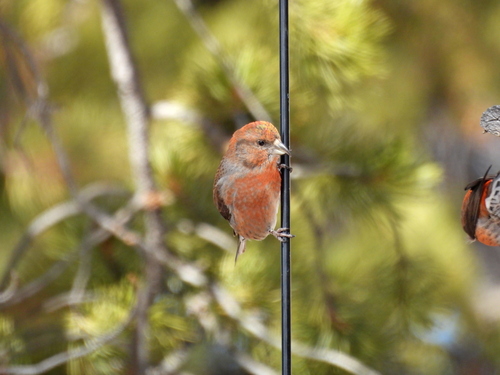 Cassia CrossbillLoxia sinesciurisThe Cassia crossbill shares many physical features with the red crossbill and all of its different call types.
Side by side: Hawfinch vs Red Crossbill · Red Crossbill vs Two-barred Crossbill · Parrot Crossbill vs Red Crossbill
Learn the Red Crossbill in the BeakBrain App
Photo and call practice. Coming soon to iPhone and Android.
Play today's Daily BirdEvery photo and recording on this page is credited to its author under the licence shown. Spotted a problem with this page, or have a better photo? Contribute.