Learn what every symbol on the card means.Full credits and sources at beakbrain.com/symbols
 GrasslandScrapeMedium · 74 g
What the Rain Quail sounds like

ID tip
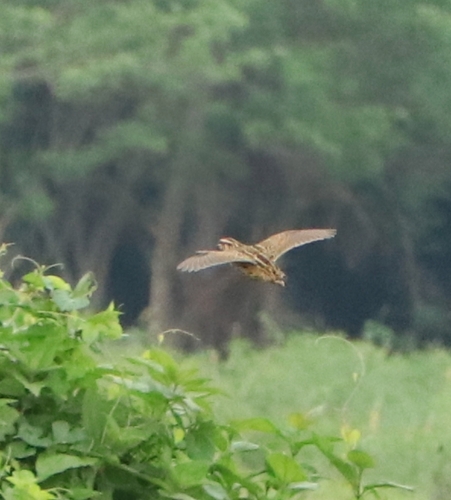
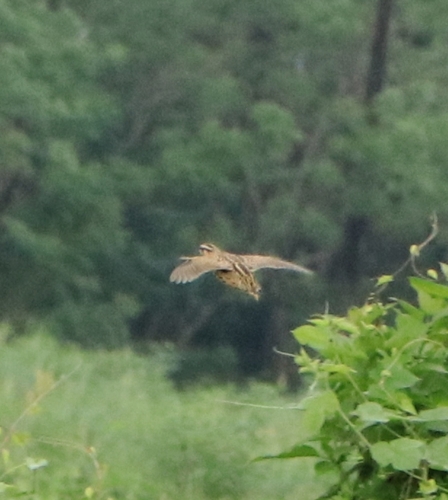
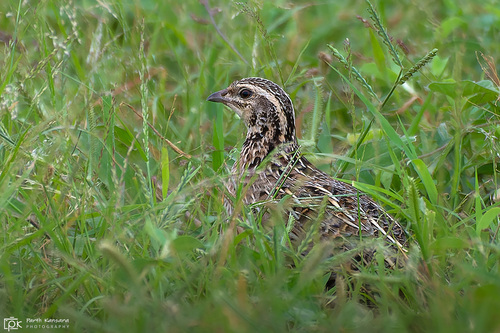
The rain quail lacks barring on primaries. The male has a black breast-patch and distinctive head pattern of black and white. The female is difficult to separate from female common quail and Japanese quail, although the spots on the breast are more delicate. It is 6–6.5 in (15–17 cm) and weighs roughly 2.25–2.5 oz (64–71 g). The call is a metallic pair of quit- quit nots, constantly repeated mornings and evenings, and in the breeding season also during the night. It is quite unmistakably distinct from the call of the common grey quail.
Text from Wikipedia, licensed CC BY-SA 4.0.
When to see the Rain Quail
One bar for each month. Filled bars are the 5 months with records; pale bars are months with none. The wide bar is August, the month with the most records.
Where to see the Rain Quail
The map shades 8 countries with regular records. Everything unshaded has no records. Countries are listed below the map.
About the Rain Quail
The rain quail or black-breasted quail is a species of quail found in the Indian Sub-continent and South-east Asia; its range including Pakistan, India, Nepal, Sri Lanka, Bangladesh, Myanmar, Thailand, Cambodia and Vietnam.
Text adapted from Wikipedia, licensed CC BY-SA 4.0.
Easily confused with
 Harlequin QuailCoturnix delegorgueiThe harlequin quail is a species of bird in the family Phasianidae.
 Japanese QuailCoturnix japonicaThe morphology of the Japanese quail differs depending on its stage in life.
 Stubble QuailCoturnix pectoralisThe stubble quail is a ground dwelling bird that is characterised by its dark brown feathers with a cream coloured strip down the centre of each feather giving rise to stripes down the length of the bird.
Side by side: Common Quail vs Rain Quail · Rain Quail vs Stubble Quail · Japanese Quail vs Rain Quail
Learn the Rain Quail in the BeakBrain App
Photo and call practice. Coming soon to iPhone and Android.
Play today's Daily BirdEvery photo and recording on this page is credited to its author under the licence shown. Spotted a problem with this page, or have a better photo? Contribute.