Learn what every symbol on the card means.Full credits and sources at beakbrain.com/symbols
 GrasslandScrapeMedium · 95 g
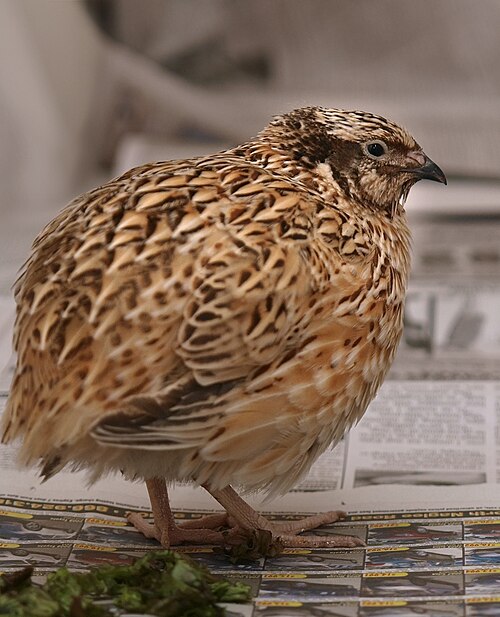
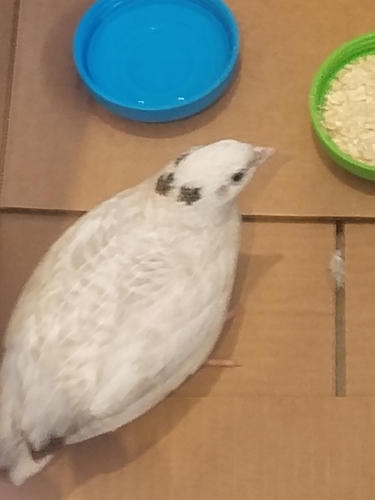
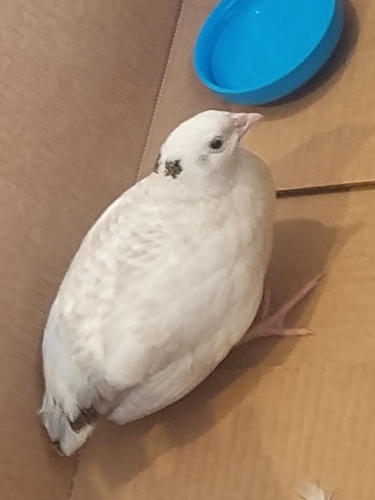

What the Japanese Quail sounds like

ID tip
The morphology of the Japanese quail differs depending on its stage in life. As chicks, both male and female individuals exhibit the same kind of plumage and coloring. Their heads are tawny in color, with small black patches littering the area above the beak. The wings and the back of the chick are a pale brown, the back also having four brown stripes running along its length. A pale yellow-brown stripe surrounded by smaller black stripes runs down the top of the head. The plumage of the Japanese quail is sexually dimorphic, allowing for differing sexes to be distinguished from one another. Voice: Some 28 different call types have been distinguished based on the circumstances in which they are used and the various behaviors that are exhibited during the call. The call types of the Japanese quail differ between male and female, the same stimulus resulting in differing vocalizations.
Text from Wikipedia, licensed CC BY-SA 4.0.
When to see the Japanese Quail
One bar for each month. Filled bars are the 11 months with records; pale bars are months with none. The wide bar is May, the month with the most records.
Where to see the Japanese Quail
The map shades 11 countries with regular records, and 12 more in a lighter tone where the bird turns up only as a stray. Everything unshaded has no records. Countries are listed below the map.
Recorded as a rare visitor in United States, Sweden, Norway, India, Thailand, Spain, Australia, Canada, North Korea, Belgium, Singapore, New Zealand.
About the Japanese Quail
The Japanese quail, also known as the coturnix quail, is a species of Old World quail found in East Asia. First considered a subspecies of the common quail, it is now considered as a separate species. The Japanese quail has played an active role in the lives of humanity since the 12th century, and continues to play major roles in industry and scientific research. Where it is found, the species is abundant across most of its range. Currently, there are a few true breeding mutations of the Japanese quail.
Text adapted from Wikipedia, licensed CC BY-SA 4.0.
Easily confused with
 Harlequin QuailCoturnix delegorgueiThe harlequin quail is a species of bird in the family Phasianidae.
 Rain QuailCoturnix coromandelicaThe rain quail lacks barring on primaries.
 Stubble QuailCoturnix pectoralisThe stubble quail is a ground dwelling bird that is characterised by its dark brown feathers with a cream coloured strip down the centre of each feather giving rise to stripes down the length of the bird.
Side by side: Japanese Quail vs Stubble Quail · Japanese Quail vs Rain Quail
Learn the Japanese Quail in the BeakBrain App
Photo and call practice. Coming soon to iPhone and Android.
Play today's Daily BirdEvery photo and recording on this page is credited to its author under the licence shown. Spotted a problem with this page, or have a better photo? Contribute.