Learn what every symbol on the card means.Full credits and sources at beakbrain.com/symbols
 WetlandPlatform nestLarge · 579 g



ID tip
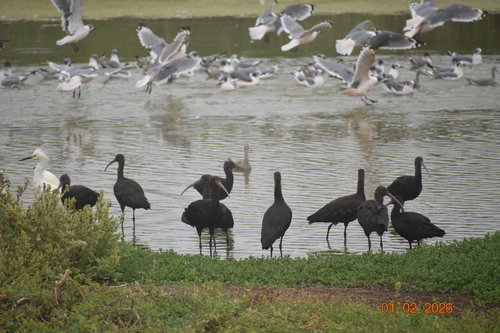
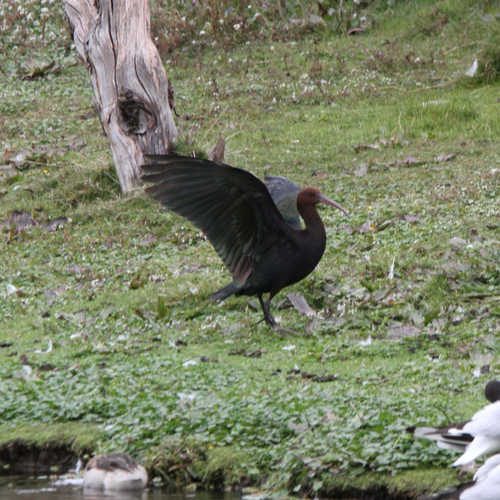
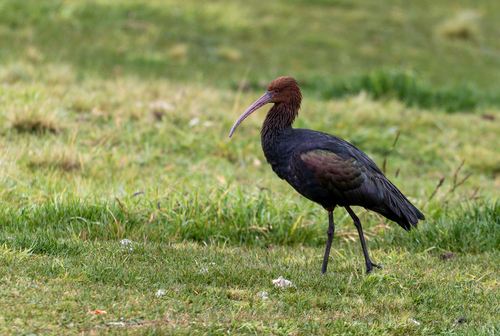
The puna ibis is a medium-sized waterbird, weighing 478–608 g (16.9–21.4 oz) and about 56–61 cm (22–24 in) tall. They can be identified by their dark purple-brown bodies, long neck, and red downward-curved bill. Their plumage has iridescence to it, offering a purple or green sheen. While there is little sexual dimorphism between male and females, a breeding adult can be recognized by its dark chestnut head and neck, with a red face and, and nonbreeding or immature individuals have white streaks on their head and neck, with a duller face. Males are also larger than females. Voice: Usually quite quiet, when disturbed puna ibis vocalize with a call that sounds like a "wut" or "cwurk". Juveniles are known to give a whispering call. The glossy ibis, plegadis falcinellus, vocalize when greeting their mates during nest relief, as well as when chicks are food-begging.
Text from Wikipedia, licensed CC BY-SA 4.0.
When to see the Puna Ibis
One bar for each month. Filled bars are the 11 months with records; pale bars are months with none. The wide bar is October, the month with the most records.
Where to see the Puna Ibis
The map shades 5 countries with regular records, and 2 more in a lighter tone where the bird turns up only as a stray. Everything unshaded has no records. Countries are listed below the map.
About the Puna Ibis
The puna ibis is a species of waterbird in the family Threskiornithidae, spoonbills and ibises. It can be found in Ecuador, Argentina, Bolivia, Chile, and Peru. It can be found in the altiplano and puna regions of the Andean highlands, inhabiting wetlands such as swamps, marshes and lakes, at an elevation of 3,000 to 4,500 metres. They migrate down to sea level to forage in coastal wetlands as well.
Text adapted from Wikipedia, licensed CC BY-SA 4.0.
Easily confused with
 White-faced IbisPlegadis chihiIn its non-breeding plumage, the white-faced ibis is very similar to the glossy ibis except that it tends to be slightly smaller and its plumage has a somewhat warmer color.
 Glossy IbisPlegadis falcinellusThis species is a mid-sized ibis.
Side by side: Glossy Ibis vs Puna Ibis · Puna Ibis vs White-faced Ibis
Learn the Puna Ibis in the BeakBrain App
Photo and call practice. Coming soon to iPhone and Android.
Play today's Daily BirdEvery photo and recording on this page is credited to its author under the licence shown. Spotted a problem with this page, or have a better photo? Contribute.