Learn what every symbol on the card means.Full credits and sources at beakbrain.com/symbols
 WetlandScrapeMedium · 80 g



What the Pectoral Sandpiper sounds like

ID tip
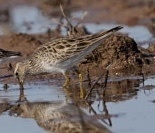
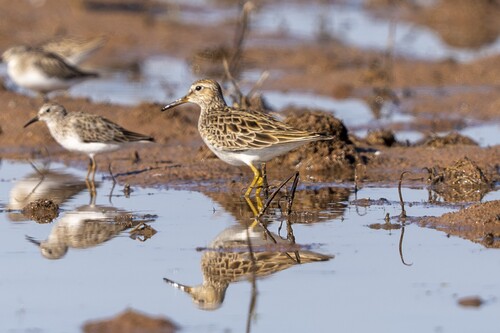
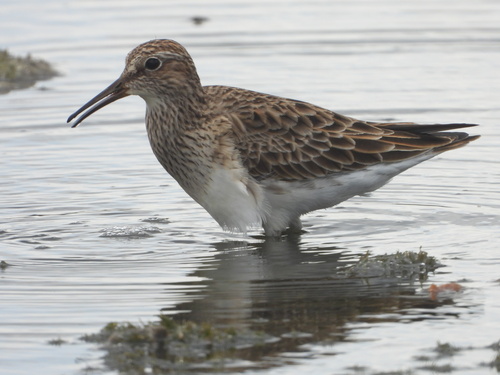
This bird looks similar to the widely sympatric sharp-tailed sandpiper (C. acuminata), which is not however a member of the same clade in the genus. The pectoral sandpiper is a largish calidrid (19–23 cm (7.5–9.1 in) in length, with a wingspan of 37–46 cm (15–18 in)) with a grey-brown back, brownest in the summer male, and greyest in winter. The pectoral sandpiper has a grey breast, sharply demarcated at its lower edge, which gives this species its English name; this clear dividing line is particularly conspicuous if the birds are turned towards the observer.
Text from Wikipedia, licensed CC BY-SA 4.0.
When to see the Pectoral Sandpiper
One bar for each month. Filled bars are the 6 months with records; pale bars are months with none. The wide bar is September, the month with the most records.
Where to see the Pectoral Sandpiper
The map shades 115 countries with regular records, and 12 more in a lighter tone where the bird turns up only as a stray. Everything unshaded has no records. Countries are listed below the map.
Recorded as a rare visitor in India, Finland, Thailand, Mongolia, Madagascar, Latvia, Algeria, Estonia, Jersey, Luxembourg, Cook Islands, Wallis & Futuna.
About the Pectoral Sandpiper
The pectoral sandpiper, often abbreviated pec, is a small, migratory wader that breeds in arctic regions of North America and Asia, wintering in South America and Oceania. It eats small invertebrates. Its nest, a hole scraped in the ground and with a thick lining, is deep enough to protect its four eggs from the cool breezes of its breeding grounds. The pectoral sandpiper is 19–23 cm (7.5–9.1 in) long, with a wingspan of 38–46 cm (15–18 in).
Text adapted from Wikipedia, licensed CC BY-SA 4.0.
Easily confused with
 Western SandpiperCalidris mauriAdults have dark legs and a short, thin, dark bill, thinner at the tip.
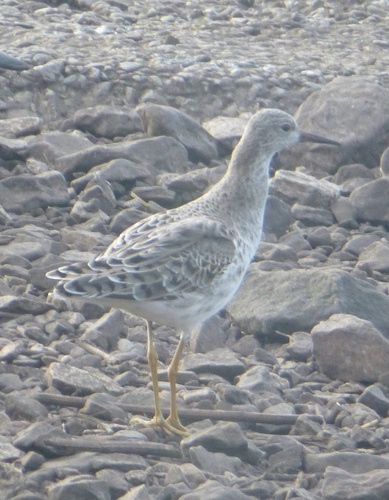 RuffCalidris pugnaxThe ruff has a distinctive pot-bellied appearance, with a small head, medium-length bill, longish neck and heavy body.
 Red KnotCalidris canutusThe red knot or just knot is a medium-sized shorebird which breeds in tundra and the Arctic Cordillera in the far north of Canada, Europe, and Russia.
Side by side: Pectoral Sandpiper vs Semipalmated Sandpiper · Pectoral Sandpiper vs Ruff · Pectoral Sandpiper vs Western Sandpiper
Learn the Pectoral Sandpiper in the BeakBrain App
Photo and call practice. Coming soon to iPhone and Android.
Play today's Daily BirdEvery photo and recording on this page is credited to its author under the licence shown. Spotted a problem with this page, or have a better photo? Contribute.