Learn what every symbol on the card means.Full credits and sources at beakbrain.com/symbols
 CoastalCup nestLarge · 1.3 kg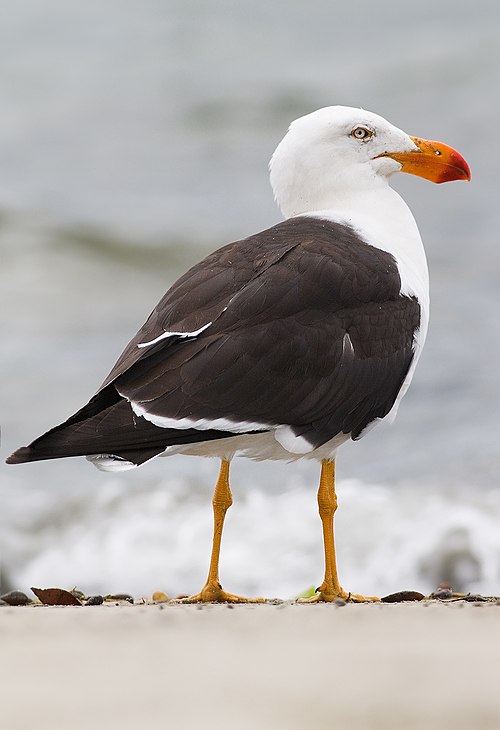


ID tip
Pacific gulls are the only large gulls in their range, besides the occasional kelp gull. This species can range in length from 58 to 66 cm (23 to 26 in) and span 137 to 157 cm (54 to 62 in) across the wings. They typically weigh from 900 to 1,180 g (1.98 to 2.60 lb). This species is mostly white, with dark wings and back, and a very thick (when compared to other gull species), powerful, red-tipped yellow bill. They have salt glands that secrete salty water through the nostrils.
Text from Wikipedia, licensed CC BY-SA 4.0.
When to see the Pacific Gull
One bar for each month, and every month is filled: this bird is recorded here in all twelve. The wide bar is January, the month with the most records.
Where to see the Pacific Gull
The map shades 1 country with regular records. Everything unshaded has no records. Countries are listed below the map.
About the Pacific Gull
The Pacific gull is a gull, native to the coasts of Australia. It is moderately common in a band along the coast between Carnarvon, Western Australia, in the west, and Sydney in the east, as well as Tasmania and other islands off the continent's southern coast. It has, however, become scarce in some parts of the south-east, as a result of competition from the kelp gull.
Text adapted from Wikipedia, licensed CC BY-SA 4.0.
Easily confused with
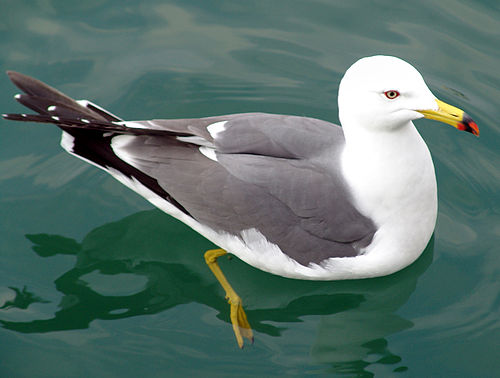 Black-tailed GullLarus crassirostrisThe black-tailed gull is medium-sized (46 cm or 18.1 in), with a wingspan of 126–128 cm (49.6–50.4 in).
 Armenian GullLarus armenicusThe Armenian gull is a fairly large gull species, though it is on average the smallest of the "herring gull" complex.
 Belcher's GullLarus belcheriBelcher's gull is 48–54 centimetres (19–21 in), with a wingspan of about 120 cm (47 in).
Side by side: Caspian Gull vs Pacific Gull · Black-tailed Gull vs Pacific Gull · Armenian Gull vs Pacific Gull · Belcher's Gull vs Pacific Gull
Learn the Pacific Gull in the BeakBrain App
Photo and call practice. Coming soon to iPhone and Android.
Play today's Daily BirdEvery photo and recording on this page is credited to its author under the licence shown. Spotted a problem with this page, or have a better photo? Contribute.