Learn what every symbol on the card means.Full credits and sources at beakbrain.com/symbols
 CoastalPlatform nestLarge · 561 g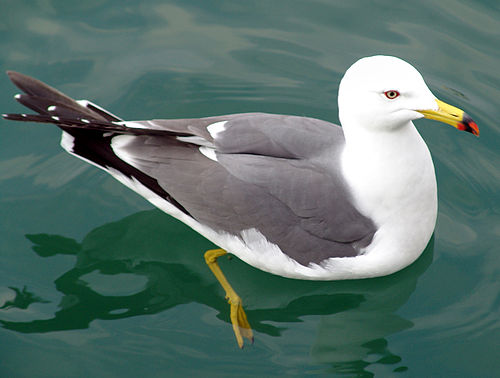


ID tip
The black-tailed gull is medium-sized (46 cm or 18.1 in), with a wingspan of 126–128 cm (49.6–50.4 in). It has yellow legs and a red and black spot at the end of the bill. Males and females have identical plumage and features, although males are larger in size than females. This gull takes four years to reach full adult plumage. As the name suggests, it has a black tail. The bird has a cat-like call, giving it its Japanese name — umineko (海猫, 'sea cat'), and Korean name — gwaeng-yi gull, which means 'cat' gull. In Hachinohe their calls are one of the 100 Soundscapes of Japan.
Text from Wikipedia, licensed CC BY-SA 4.0.
When to see the Black-tailed Gull
One bar for each month, and every month is filled: this bird is recorded here in all twelve. The wide bar is May, the month with the most records.
Where to see the Black-tailed Gull
The map shades 13 countries with regular records, and 3 more in a lighter tone where the bird turns up only as a stray. Everything unshaded has no records. Countries are listed below the map.
Recorded as a rare visitor in United States, Canada, Australia.
About the Black-tailed Gull
The black-tailed gull is a gull native to shorelines of East Asia.
Text adapted from Wikipedia, licensed CC BY-SA 4.0.
Easily confused with
 Armenian GullLarus armenicusThe Armenian gull is a fairly large gull species, though it is on average the smallest of the "herring gull" complex.
 Belcher's GullLarus belcheriBelcher's gull is 48–54 centimetres (19–21 in), with a wingspan of about 120 cm (47 in).
 Slaty-backed GullLarus schistisagusIt is tied with the yellow-footed gull for fourth-largest gull species, measuring 55–68.5 cm (21.7–27.0 in) in length, 132–160 cm (52–63 in) in wingspan, and 1.05–1.7 kg (2.3–3.7 lb) in weight.
Side by side: Black-tailed Gull vs Caspian Gull · Black-tailed Gull vs Pacific Gull · Armenian Gull vs Black-tailed Gull · Belcher's Gull vs Black-tailed Gull · Black-tailed Gull vs Slaty-backed Gull
Learn the Black-tailed Gull in the BeakBrain App
Photo and call practice. Coming soon to iPhone and Android.
Play today's Daily BirdEvery photo and recording on this page is credited to its author under the licence shown. Spotted a problem with this page, or have a better photo? Contribute.