Learn what every symbol on the card means.Full credits and sources at beakbrain.com/symbols
 WoodlandPlatform nestMedium · 233 g


ID tip
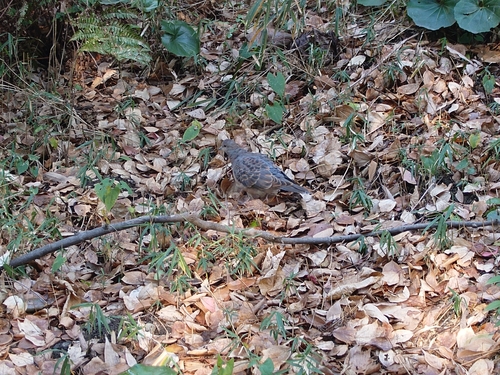
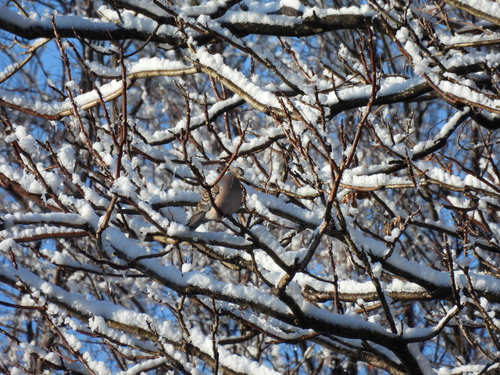
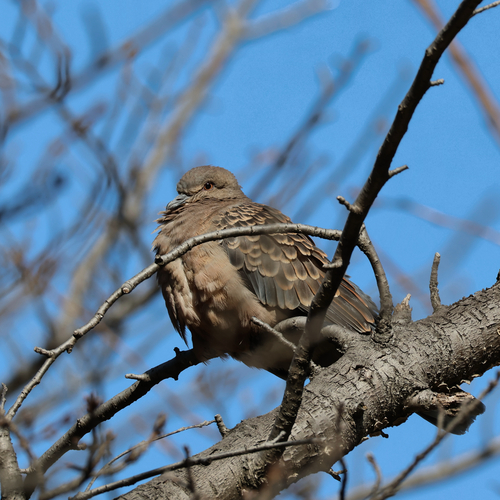
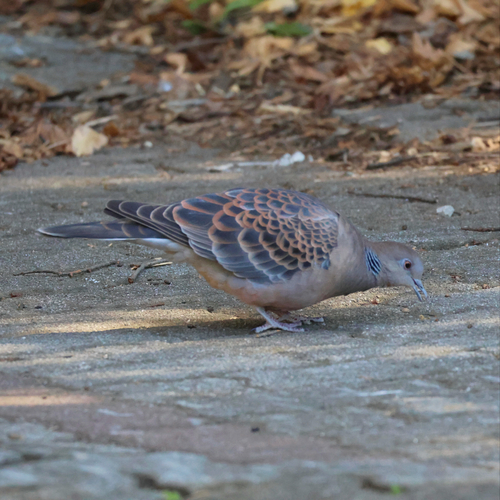
The Oriental dove is very similar in plumage to the Turtle dove. It is a little larger than that species, particularly in the case of orientalis, about the same size as a collared dove. It shares the black and white striped patch on the side of its neck made of silver-tipped feathers, but the breast is less pink, and the orange-brown wing feathers of the turtle dove are replaced with a browner hue, and darker centres giving a scaly appearance. The tail is wedge shaped, like the turtle dove. The flight is more relaxed and direct than that of its relative. Voice: The calls are different from the purring of the European turtle dove. It is a four-syllable her-her-oo-oo. There are significant call differences within the populations as well.
Text from Wikipedia, licensed CC BY-SA 4.0.
When to see the Oriental Turtle Dove
One bar for each month, and every month is filled: this bird is recorded here in all twelve. The wide bar is April, the month with the most records.
Where to see the Oriental Turtle Dove
The map shades 44 countries with regular records, and 13 more in a lighter tone where the bird turns up only as a stray. Everything unshaded has no records. Countries are listed below the map.
Recorded as a rare visitor in United States, United Kingdom, Canada, Germany, Netherlands, Finland, Belgium, France, Denmark, Türkiye, Turkmenistan, Cyprus, Faroe Islands.
About the Oriental Turtle Dove
The Oriental turtle dove or rufous turtle dove is a member of the bird family Columbidae. The species has a wide native distribution range from Central Asia east across Asia to Japan. The populations show variations in the patterning of plumage and have been designated into at least six named subspecies. Populations in the higher latitudes tend to migrate south in winter, while those closer to the tropics are sedentary. Vagrants have been recorded in North America. The species is predominantly granivorous and forages on the ground.
Text adapted from Wikipedia, licensed CC BY-SA 4.0.
Easily confused with
 Red Collared DoveStreptopelia tranquebaricaThe red collared dove is a relatively small species, with a length of 20.5–23 cm (8.1–9.1 in) and a weight of around 104 g (3.7 oz).
 European Turtle DoveStreptopelia turturThe European turtle dove is smaller and more slender than many other doves.
 Red-eyed DoveStreptopelia semitorquataThe red-eyed dove's pale bluish gray forehead merges into a darker hue on the crown.
Side by side: European Turtle Dove vs Oriental Turtle Dove · Oriental Turtle Dove vs Red Collared Dove · Oriental Turtle Dove vs Red-eyed Dove
Learn the Oriental Turtle Dove in the BeakBrain App
Photo and call practice. Coming soon to iPhone and Android.
Play today's Daily BirdEvery photo and recording on this page is credited to its author under the licence shown. Spotted a problem with this page, or have a better photo? Contribute.