Learn what every symbol on the card means.Full credits and sources at beakbrain.com/symbols
 WetlandPlatform nestLarge · 613 g

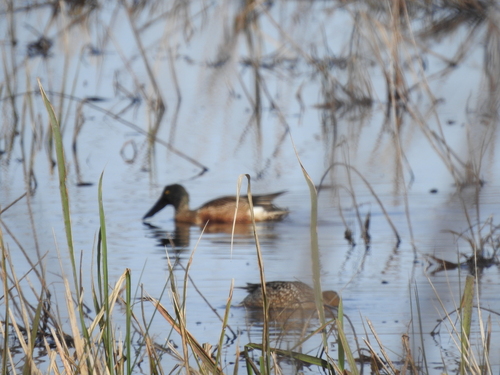
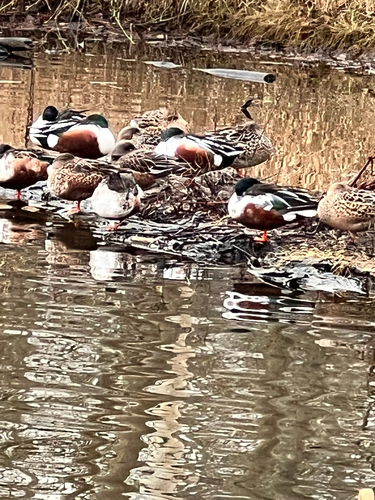
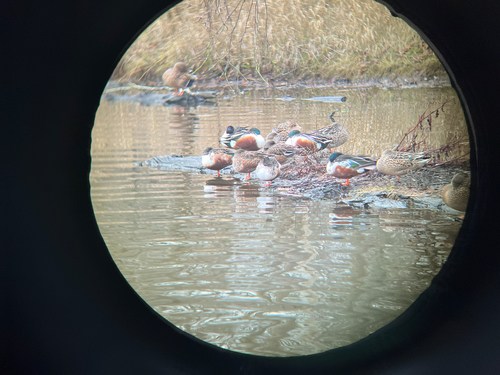

What the Northern Shoveler sounds like


ID tip
This species is unmistakable in the Northern Hemisphere due to its large, spatulated bill. The breeding drake has an iridescent, dark green head, though less intensely iridescent than a drake mallard's head, and appears black at distance or in poor light, white breast, and chestnut belly and flanks, and a black or very dark grey bill. In flight, pale blue forewing feathers are revealed, separated from the green speculum by a white border. In early autumn, the male has a white crescent on each side of the face.
Text from Wikipedia, licensed CC BY-SA 4.0.
When to see the Northern Shoveler
One bar for each month. Filled bars are the 9 months with records; pale bars are months with none. The wide bar is April, the month with the most records.
Where to see the Northern Shoveler
The map shades 153 countries with regular records, and 10 more in a lighter tone where the bird turns up only as a stray. Everything unshaded has no records. Countries are listed below the map.
Recorded as a rare visitor in South Africa, Peru, Chile, Seychelles, Argentina, French Guiana, Niger, Montserrat, St. Barthélemy, Micronesia.
About the Northern Shoveler
The northern shoveler, often known simply as the shoveler where other related species do not occur, is a common and widespread duck. It breeds in northern areas of Europe and throughout the Palearctic and across most of North America, and winters in southern Europe, the Indian subcontinent, Southeast Asia, Central America, the Caribbean, and northern South America. It is a rare vagrant to Australia. In North America, it breeds along the southern edge of Hudson Bay and west of this body of water, and as far south as the Great Lakes west to Colorado, Nevada, and Oregon.
Text adapted from Wikipedia, licensed CC BY-SA 4.0.
Easily confused with
 Blue-winged TealSpatula discorsThe blue-winged teal is 40 cm (16 in) long, with a wingspan of 58 cm (23 in), and a weight of 370 g (13 oz).
 Cinnamon TealSpatula cyanopteraThe adult male has a cinnamon-red head and body with a brown back, a red eye and a dark bill.
 GarganeySpatula querquedulaThe adult male is unmistakable, with its brown head and breast with a broad white crescent over the eye.
Side by side: Blue-winged Teal vs Northern Shoveler · Cinnamon Teal vs Northern Shoveler · Garganey vs Northern Shoveler
Learn the Northern Shoveler in the BeakBrain App
Photo and call practice. Coming soon to iPhone and Android.
Play today's Daily BirdEvery photo and recording on this page is credited to its author under the licence shown. Spotted a problem with this page, or have a better photo? Contribute.