Learn what every symbol on the card means.Full credits and sources at beakbrain.com/symbols
 WetlandScrapeLarge · 326 g





What the Garganey sounds like


ID tip
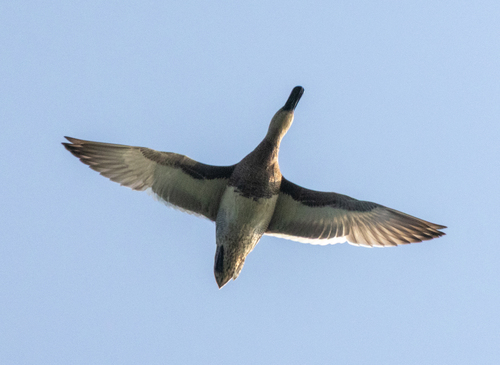
The adult male is unmistakable, with its brown head and breast with a broad white crescent over the eye. The rest of the plumage is grey, with loose grey scapular feathers. It has a grey bill and legs. In flight, it shows a pale blue speculum with a white border. When swimming it will show prominent white edges on its tertials. His crown (anatomy) is dark and his face is reddish brown. Some care is needed in separating the brown female from the similar common teal, but the stronger face markings and more frequent head-shaking when dabbling are good indicators.
Text from Wikipedia, licensed CC BY-SA 4.0.
When to see the Garganey
One bar for each month. Filled bars are the 8 months with records; pale bars are months with none. The wide bar is May, the month with the most records.
Where to see the Garganey
The map shades 125 countries with regular records, and 10 more in a lighter tone where the bird turns up only as a stray. Everything unshaded has no records. Countries are listed below the map.
Recorded as a rare visitor in Canada, Burkina Faso, Mayotte, South Sudan, Martinique, Mexico, St. Pierre & Miquelon, Maldives, Turkmenistan, Faroe Islands.
About the Garganey
The garganey is a small dabbling duck. It breeds in much of Europe and across the Palearctic, but is strictly migratory, with the entire population moving to Africa, India, Bangladesh and Australasia during the winter of the Northern hemisphere, where large flocks can occur. This species was first described by Carl Linnaeus in his landmark 1758 10th edition of Systema Naturae. Like other small ducks such as the Eurasian teal, this species rises easily from the water with a fast twisting wader-like flight.
Text adapted from Wikipedia, licensed CC BY-SA 4.0.
Easily confused with
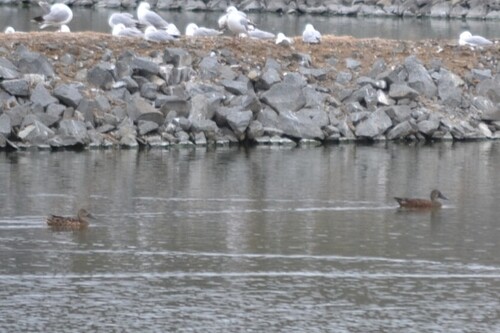 Australasian ShovelerSpatula rhynchotisThe Australasian shoveler is a species of dabbling duck in the genus Spatula.
 Cape ShovelerSpatula smithiiThe Cape shoveler or Cape shoveller is a species of dabbling duck of the genus Spatula.
 Silver TealSpatula versicolorThey have a black cap that extends below the eyes, and a bluish bill with a yellow tip.
Side by side: Garganey vs Northern Shoveler · Blue-winged Teal vs Garganey · Cinnamon Teal vs Garganey · Garganey vs Silver Teal
Learn the Garganey in the BeakBrain App
Photo and call practice. Coming soon to iPhone and Android.
Play today's Daily BirdEvery photo and recording on this page is credited to its author under the licence shown. Spotted a problem with this page, or have a better photo? Contribute.