Learn what every symbol on the card means.Full credits and sources at beakbrain.com/symbols
 WetlandPlatform nestLarge · 595 g






ID tip
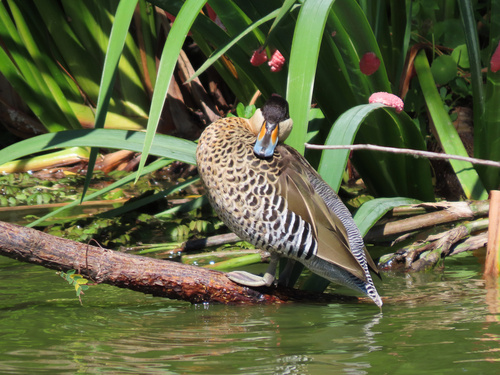
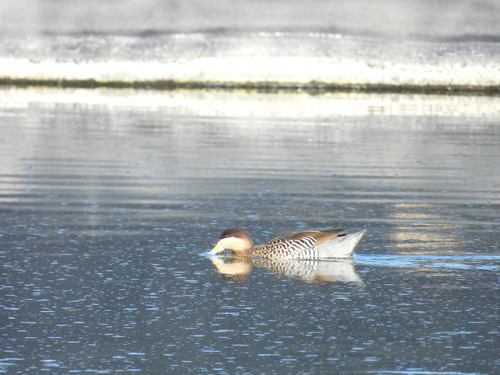
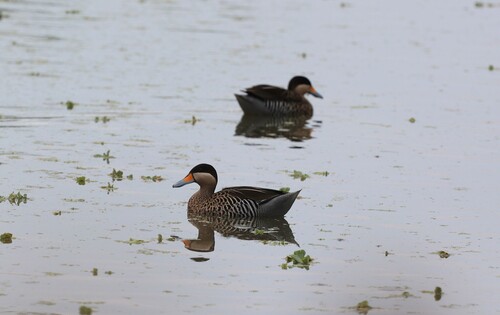
They have a black cap that extends below the eyes, and a bluish bill with a yellow tip. They also have a green speculum with a white border. The female's plumage is slightly duller and has less yellow at the base of the beak. The Puna teal was previously regarded as a subspecies of this bird. Currently, there are two subspecies: S. versicolor versicolor northern silver teal located in Paraguay, southern Bolivia, and southern Brazil. S. versicolor fretensis southern silver teal located in southern Chile, Argentina, and the Falkland Islands.
Text from Wikipedia, licensed CC BY-SA 4.0.
When to see the Silver Teal
One bar for each month, and every month is filled: this bird is recorded here in all twelve. The wide bar is October, the month with the most records.
Where to see the Silver Teal
The map shades 7 countries with regular records, and 6 more in a lighter tone where the bird turns up only as a stray. Everything unshaded has no records. Countries are listed below the map.
Recorded as a rare visitor in France, Germany, Belgium, United Kingdom, Netherlands, United Arab Emirates.
About the Silver Teal
The silver teal or versicolor teal is a species of dabbling duck in the genus Spatula. It breeds in South America.
Text adapted from Wikipedia, licensed CC BY-SA 4.0.
Easily confused with
 Red ShovelerSpatula plataleaThe species has a spatula-shaped bill, a green speculum, and light blue upper wing converts.
 Cape ShovelerSpatula smithiiThe Cape shoveler or Cape shoveller is a species of dabbling duck of the genus Spatula.
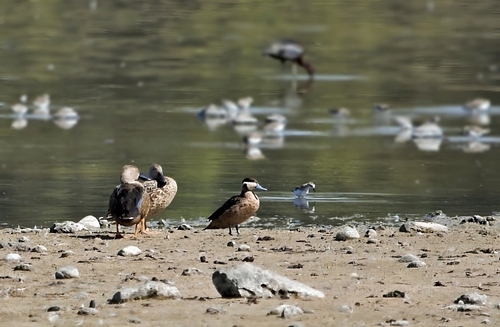 Blue-billed TealSpatula hottentotaAdult males have dark brown crown contrasting with paler face, throat, breast and side except for a blackish thumb-shaped patch on the ear region.
Side by side: Garganey vs Silver Teal · Red Shoveler vs Silver Teal · Blue-billed Teal vs Silver Teal · Puna Teal vs Silver Teal
Learn the Silver Teal in the BeakBrain App
Photo and call practice. Coming soon to iPhone and Android.
Play today's Daily BirdEvery photo and recording on this page is credited to its author under the licence shown. Spotted a problem with this page, or have a better photo? Contribute.