Learn what every symbol on the card means.Full credits and sources at beakbrain.com/symbols
 ForestCavity nestMedium · 101 g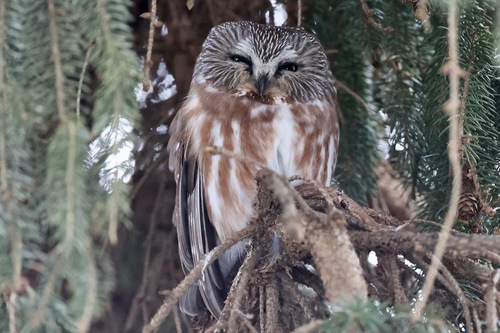
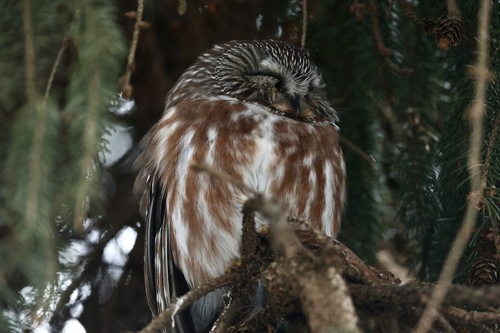


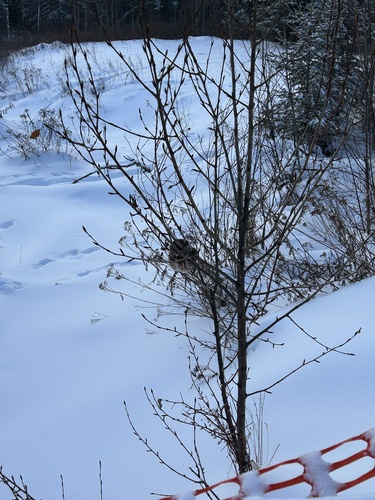
What the Northern Saw-whet Owl sounds like

ID tip
Adults are 17–22 cm (6.7–8.7 in) long with a 42–56.3 cm (16.5–22.2 in) wingspan. They can weigh from 54 to 151 g (1.9 to 5.3 oz) with an average of around 80 g (2.8 oz), making them one of the smallest owls in North America. They are similar in size to the American robin (78.5 g). Northern saw-whet owls do not exhibit sexual dimorphism in their plumage, so are often sexed by size dimorphism—females are larger than males. Females on average weigh 100 g and males on average weigh 75 g. Northern saw-whet owls have porphyrin pigments in their flight feathers. Voice: The northern saw-whet owl makes a repeated tooting whistle sound. Some say they sound like a saw being sharpened on a whetstone. These calls are usually produced by males searching for mates, so they can be heard more often beginning in January and continuing through the end of the breeding season in early July. Despite being more common in spring, they do vocalize year round.
Text from Wikipedia, licensed CC BY-SA 4.0.
When to see the Northern Saw-whet Owl
One bar for each month. Filled bars are the 10 months with records; pale bars are months with none. The wide bar is January, the month with the most records.
Where to see the Northern Saw-whet Owl
The map shades 5 countries with regular records. Everything unshaded has no records. Countries are listed below the map.
About the Northern Saw-whet Owl
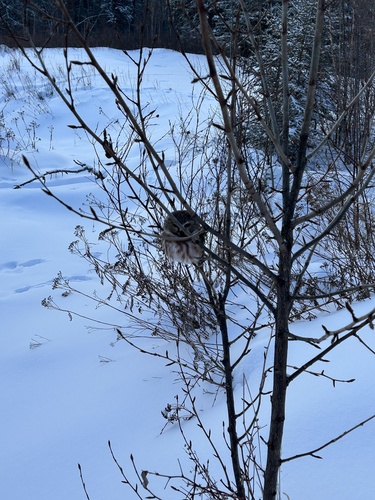
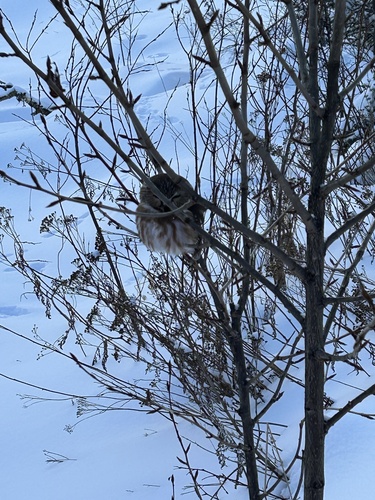
The northern saw-whet owl is a species of small owl in the family Strigidae. The species is native to North America. Saw-whet owls of the genus Aegolius are some of the smallest owl species in North America. They can be found in dense thickets, often at eye level, although they can also be found some 20 ft (6.1 m) up. Saw-whets are often in danger of being preyed upon by larger birds of prey. The northern saw-whet owl is a migratory bird without any strict pattern.
Text adapted from Wikipedia, licensed CC BY-SA 4.0.
Easily confused with
 Buff-fronted OwlAegolius harrisiiThe buff-fronted owl is 19 to 21 cm (7.5 to 8.3 in) long and weighs 104 to 155 g (3.7 to 5.5 oz).
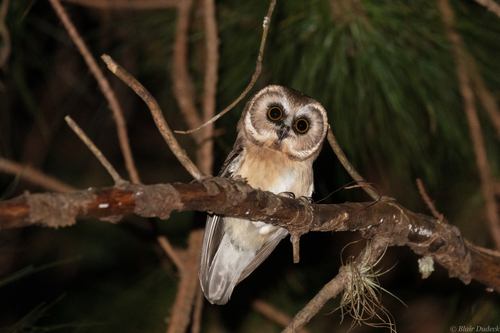 Unspotted Saw-whet OwlAegolius ridgwayiThe unspotted saw-whet owl is 18 to 21.5 cm (7.1 to 8.5 in) long and weighs about 80 to 90 g (2.8 to 3.2 oz).
 Boreal OwlAegolius funereusThe boreal owl is small with a large head and long wings.
Side by side: Boreal Owl vs Northern Saw-whet Owl
Learn the Northern Saw-whet Owl in the BeakBrain App
Photo and call practice. Coming soon to iPhone and Android.
Play today's Daily BirdEvery photo and recording on this page is credited to its author under the licence shown. Spotted a problem with this page, or have a better photo? Contribute.