Learn what every symbol on the card means.Full credits and sources at beakbrain.com/symbols
 ForestCavity nestMedium · 137 g


What the Boreal Owl sounds like


ID tip
The boreal owl is small with a large head and long wings. Both sexes are similar in appearance, though females are larger. Males typically measure 21–25 cm (8–10 in) in length, with a wingspan of 55–58 cm (22–23 in), while females are larger, 25–28 cm (10–11 in), with a wingspan of 59–62 cm (23–24 in). Females, weighing 132–215 g (4.7–7.6 oz) are heavier than males, which weigh 93–139 g (3.3–4.9 oz).
Text from Wikipedia, licensed CC BY-SA 4.0.
When to see the Boreal Owl
One bar for each month. Filled bars are the 7 months with records; pale bars are months with none. The wide bar is March, the month with the most records.
Where to see the Boreal Owl
The map shades 37 countries with regular records, and 7 more in a lighter tone where the bird turns up only as a stray. Everything unshaded has no records. Countries are listed below the map.
Recorded as a rare visitor in Belgium, United Kingdom, Mongolia, Netherlands, Georgia, India, Luxembourg.
About the Boreal Owl
The boreal owl or Tengmalm's owl is a small owl in the "true owl" family Strigidae. It is known as the boreal owl or, more rarely, Richardson's owl after Sir John Richardson, in North America, and as Tengmalm's owl in Europe and Asia, after the Swedish naturalist Peter Gustaf Tengmalm.
Text adapted from Wikipedia, licensed CC BY-SA 4.0.
Easily confused with
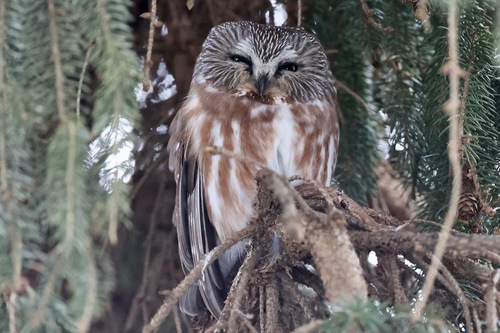 Northern Saw-whet OwlAegolius acadicusAdults are 17–22 cm (6.7–8.7 in) long with a 42–56.3 cm (16.5–22.2 in) wingspan.
 Buff-fronted OwlAegolius harrisiiThe buff-fronted owl is 19 to 21 cm (7.5 to 8.3 in) long and weighs 104 to 155 g (3.7 to 5.5 oz).
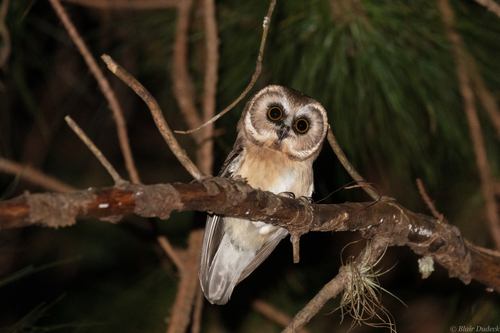 Unspotted Saw-whet OwlAegolius ridgwayiThe unspotted saw-whet owl is 18 to 21.5 cm (7.1 to 8.5 in) long and weighs about 80 to 90 g (2.8 to 3.2 oz).
Side by side: Boreal Owl vs Northern Saw-whet Owl
Learn the Boreal Owl in the BeakBrain App
Photo and call practice. Coming soon to iPhone and Android.
Play today's Daily BirdEvery photo and recording on this page is credited to its author under the licence shown. Spotted a problem with this page, or have a better photo? Contribute.