
Boreal Owl
Aegolius funereus
The boreal owl is small with a large head and long wings. Both sexes are similar in appearance, though females are larger. Males typically measure 21–25 cm (8–10 in) in length, with a wingspan of 55–58 cm (22–23 in), while females are larger, 25–28 cm (10–11 in), with a wingspan of 59–62 cm (23–24 in). Females, weighing 132–215 g (4.7–7.6 oz) are heavier than males, which weigh 93–139 g (3.3–4.9 oz).
ID text from Wikipedia, CC BY-SA 4.0

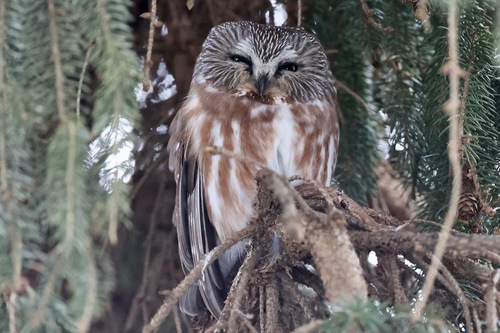
Northern Saw-whet Owl
Aegolius acadicus
Adults are 17–22 cm (6.7–8.7 in) long with a 42–56.3 cm (16.5–22.2 in) wingspan. They can weigh from 54 to 151 g (1.9 to 5.3 oz) with an average of around 80 g (2.8 oz), making them one of the smallest owls in North America. They are similar in size to the American robin (78.5 g). Northern saw-whet owls do not exhibit sexual dimorphism in their plumage, so are often sexed by size dimorphism—females are larger than males. Females on average weigh 100 g and males on average weigh 75 g. Northern saw-whet owls have porphyrin pigments in their flight feathers. Voice: The northern saw-whet owl makes a repeated tooting whistle sound. Some say they sound like a saw being sharpened on a whetstone. These calls are usually produced by males searching for mates, so they can be heard more often beginning in January and continuing through the end of the breeding season in early July. Despite being more common in spring, they do vocalize year round.
ID text from Wikipedia, CC BY-SA 4.0

Where you might meet both
Learn this pair in the BeakBrain App
Photo and call practice. Coming soon to iPhone and Android.
Play today's Daily BirdPhotos and recordings are credited to their authors under the licence shown. Full profiles: Boreal Owl and Northern Saw-whet Owl.