Learn what every symbol on the card means.Full credits and sources at beakbrain.com/symbols
 RockyCavity nestSmall · 22 g


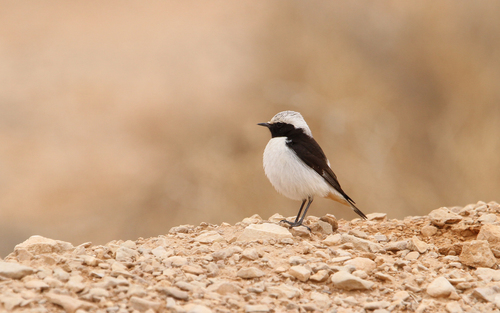
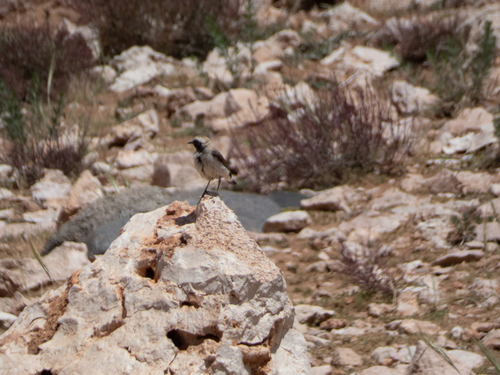
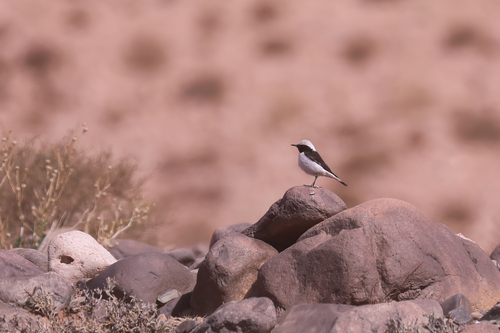
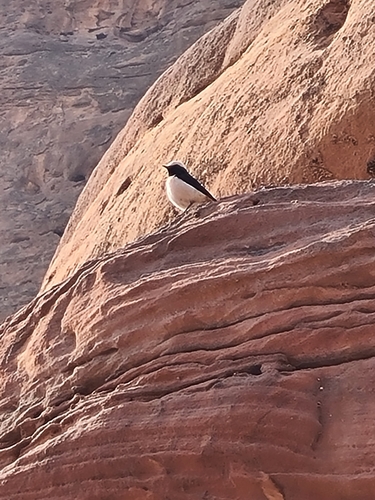
ID tip
The mourning wheatear measures 14–16 cm (5.5–6.3 in) in length and weighs between 19–25 g (0.67–0.88 oz). It is characterised by its striking black-and-white plumage. Both males and females share a similar appearance, featuring a white crown, nape, chest, and belly that contrast with the black head and neck, which extend to the black back. The tail is predominantly white, marked by a black stripe at the tip and a central black intrusion forming an inverted "T" pattern, a characteristic feature of wheatears.
Text from Wikipedia, licensed CC BY-SA 4.0.
When to see the Mourning Wheatear
One bar for each month. Filled bars are the 10 months with records; pale bars are months with none. The wide bar is March, the month with the most records.
Where to see the Mourning Wheatear
The map shades 24 countries with regular records. Everything unshaded has no records. Countries are listed below the map.
About the Mourning Wheatear
The mourning wheatear is a bird, one of 14 species of wheatear found in northern Africa and the Middle East. It is a small passerine in a group formerly classed as members of the thrush family Turdidae, but now more generally considered to be part of the Old World flycatcher family Muscicapidae.
Text adapted from Wikipedia, licensed CC BY-SA 4.0.
Easily confused with
 Finsch's WheatearOenanthe finschiiA medium-sized elegant wheatear with long wings and long legs.
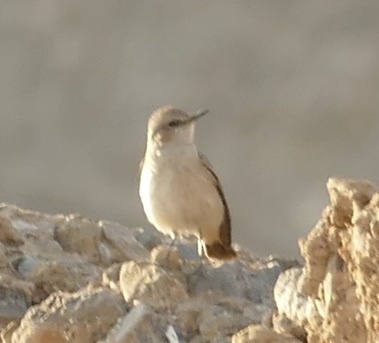 Red-tailed WheatearOenanthe chrysopygiaIt is 14.5 cm long with a wingspan of 26–27 cm and a weight of about 20-27 g.
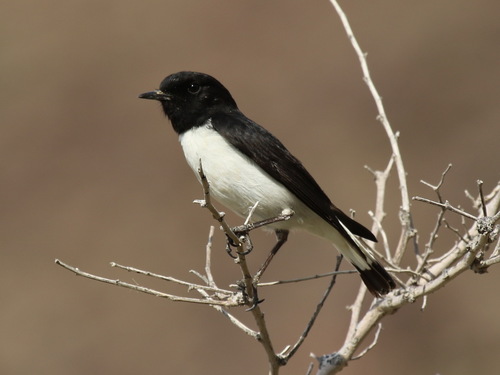 Hume's WheatearOenanthe albonigraHume's wheatear is a large wheatear with a dark black head and back contrasting sharply with a pure white breast and belly.
Side by side: Mourning Wheatear vs Variable Wheatear · Mourning Wheatear vs White-starred Robin · Finsch's Wheatear vs Mourning Wheatear · Mourning Wheatear vs Red-tailed Wheatear · Hume's Wheatear vs Mourning Wheatear
Learn the Mourning Wheatear in the BeakBrain App
Photo and call practice. Coming soon to iPhone and Android.
Play today's Daily BirdEvery photo and recording on this page is credited to its author under the licence shown. Spotted a problem with this page, or have a better photo? Contribute.