
Mourning Wheatear
Oenanthe lugens
The mourning wheatear measures 14–16 cm (5.5–6.3 in) in length and weighs between 19–25 g (0.67–0.88 oz). It is characterised by its striking black-and-white plumage. Both males and females share a similar appearance, featuring a white crown, nape, chest, and belly that contrast with the black head and neck, which extend to the black back. The tail is predominantly white, marked by a black stripe at the tip and a central black intrusion forming an inverted "T" pattern, a characteristic feature of wheatears.
ID text from Wikipedia, CC BY-SA 4.0
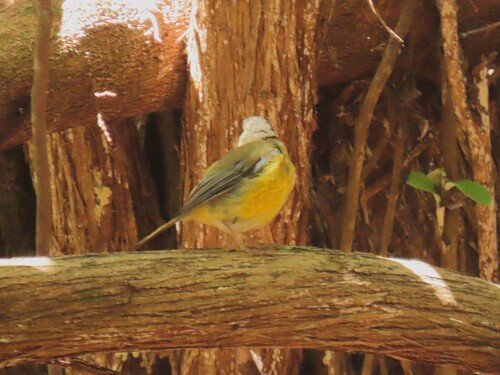
White-starred Robin
Pogonocichla stellata
The white-starred robin is a small robin, 15 to 16 cm (5.9–6.3 in) in length and weighing between 18 and 25 g (0.63–0.88 oz), with the females being slightly smaller than the males. The plumage of the nominate race is slate-grey on the head, with a white spot in front of each eye and another small one on the throat. The mantle and part of the wings are green (moss-green in the mantle, olive-green on the wings), the rest of the wings are bluish grey, and the tail is black with yellow lateral stripes. The breast and belly are bright yellow, and the legs are pinkish. Voice: The calls and songs of the white-starred robin are geographically variable. Both sexes sing the territorial advertising song, which is a quiet song sung from near the ground. The courtship call is sung during a display flight, and is rendered as a sustained "wiii wii wiii". The loud contact call, also used as a warning call, varies by subspecies.
ID text from Wikipedia, CC BY-SA 4.0
Where you might meet both
Learn this pair in the BeakBrain App
Photo and call practice. Coming soon to iPhone and Android.
Play today's Daily BirdPhotos and recordings are credited to their authors under the licence shown. Full profiles: Mourning Wheatear and White-starred Robin.