Learn what every symbol on the card means.Full credits and sources at beakbrain.com/symbols
 ForestScrapeLarge · 1.1 kg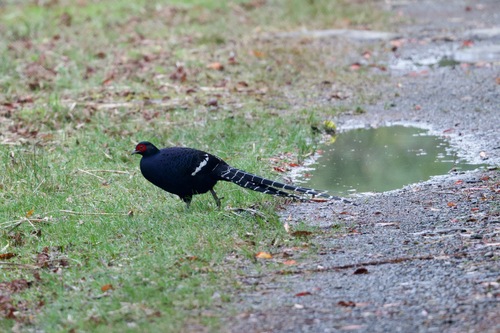


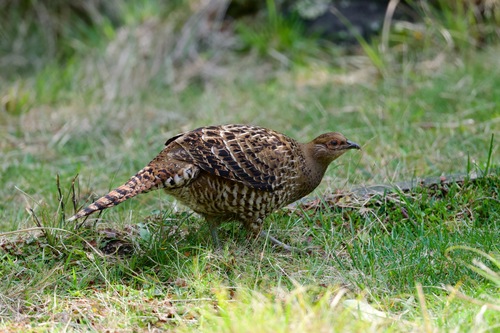
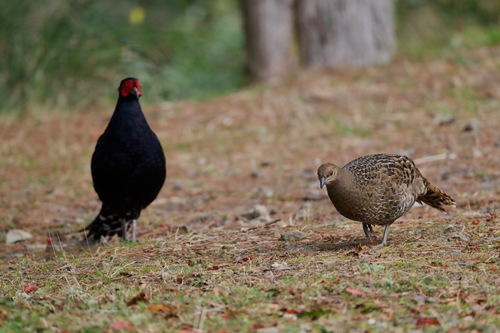
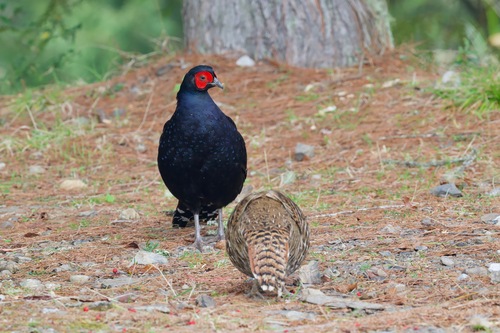
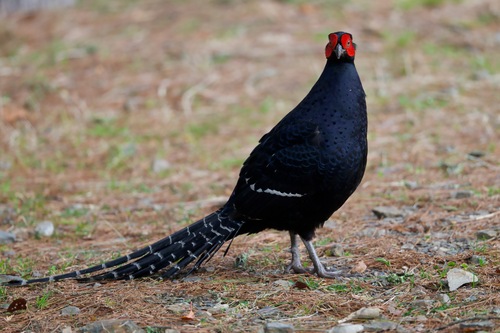
ID tip
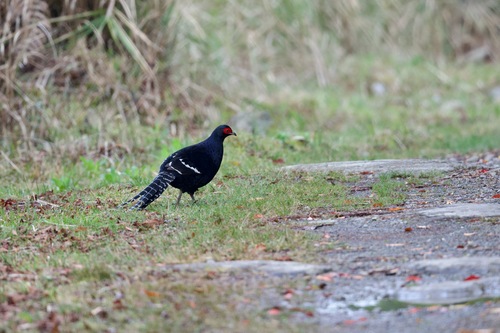
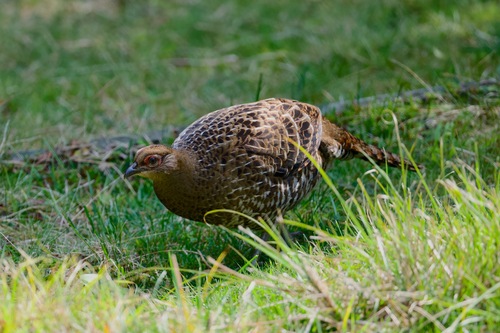
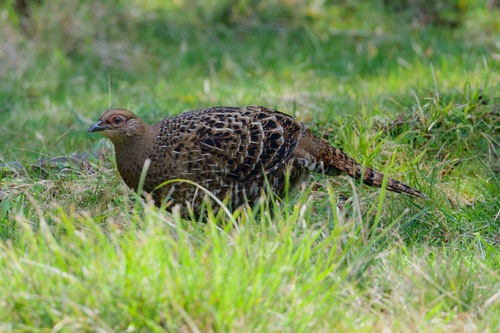
With the tail included, males of this species get to be up to 70 cm in body length, while the smaller females measure up to 47 cm. The male is dark with plumage that refracts with blue or violet iridescence, with white stripes on its wings and tail. The female is brown and speckled with brown and white quills. The long and striped tail feathers of the male were used by the Taiwanese aborigines as a head-dress decoration. The type specimen of the pheasant comprises two such tail feathers obtained in 1906 by collector Walter Goodfellow from the head-dress of one of his porters. Voice: There are five commonly heard vocalizations of the Mikado pheasant: a deep "gu, gu, gu" sound, which is the most frequently heard and often heard continuously when they are in a relaxed state, while walking or pecking the ground. Another vocalization is a higher-pitched "ko, ko, ko," typically produced during the mating season or when they sense nearby threat.
Text from Wikipedia, licensed CC BY-SA 4.0.
When to see the Mikado Pheasant
One bar for each month, and every month is filled: this bird is recorded here in all twelve. The wide bar is April, the month with the most records.
Where to see the Mikado Pheasant
The map shades 2 countries with regular records. Everything unshaded has no records. Countries are listed below the map.
About the Mikado Pheasant
The Mikado pheasant is a species of gamebird in the pheasant family Phasianidae of the order Galliformes, gallinaceous birds. Sometimes considered an unofficial national bird of Taiwan, a pair of Mikado pheasants and Yushan National Park, one of the areas it is known to inhabit, is depicted in the 1000 dollar bill of the New Taiwan dollar.
Text adapted from Wikipedia, licensed CC BY-SA 4.0.
Easily confused with
 Reeves's PheasantSyrmaticus reevesiiMales measure 210 cm (83 in) long and weigh 1,529 g (3.371 lb).
 Mrs. Hume's PheasantSyrmaticus humiaeThe pheasant is up to 90 cm (35 in) long with a greyish brown head, bare red facial skin, chestnut brown plumage, yellowish bill, brownish orange iris, white wingbars and metallic blue neck feathers.
 Copper PheasantSyrmaticus soemmerringiiIt is a large pheasant with a rich coppery chestnut plumage, yellowish bill, brown iris, and red facial skin.
Learn the Mikado Pheasant in the BeakBrain App
Photo and call practice. Coming soon to iPhone and Android.
Play today's Daily BirdEvery photo and recording on this page is credited to its author under the licence shown. Spotted a problem with this page, or have a better photo? Contribute.