Learn what every symbol on the card means.Full credits and sources at beakbrain.com/symbols
 ForestLarge · 873 g

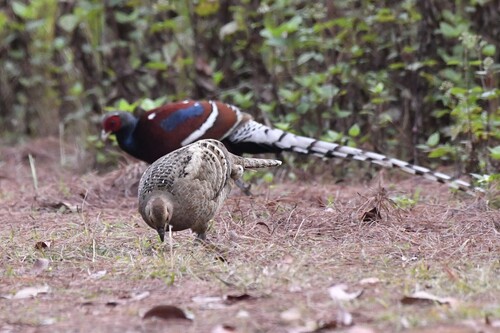


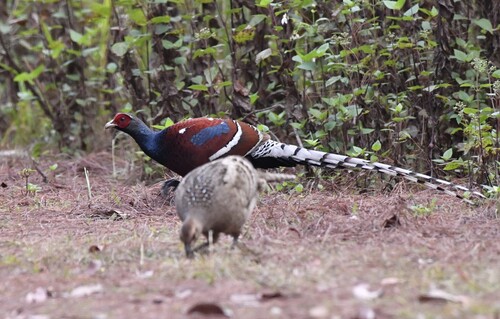
ID tip
The pheasant is up to 90 cm (35 in) long with a greyish brown head, bare red facial skin, chestnut brown plumage, yellowish bill, brownish orange iris, white wingbars and metallic blue neck feathers. The male has a long greyish white, barred black and brown tail. The female is a chestnut brown bird with whitish throat, buff colour belly and white-tipped tail.
Text from Wikipedia, licensed CC BY-SA 4.0.
When to see the Mrs. Hume's Pheasant
One bar for each month. Filled bars are the 6 months with records; pale bars are months with none. The wide bar is February, the month with the most records.
Where to see the Mrs. Hume's Pheasant
The map shades 3 countries with regular records, and 1 more in a lighter tone where the bird turns up only as a stray. Everything unshaded has no records. Countries are listed below the map.
Recorded as a rare visitor in India.
About the Mrs. Hume's Pheasant
Mrs. Hume's pheasant, also known as Hume's pheasant or the bar-tailed pheasant, is a large forest pheasant. It is the state bird of Mizoram and Manipur. The name commemorates Mary Ann Grindall Hume, wife of the British naturalist Allan Octavian Hume, one of the key founders of the Indian National Congress.
Text adapted from Wikipedia, licensed CC BY-SA 4.0.
Easily confused with
 Copper PheasantSyrmaticus soemmerringiiIt is a large pheasant with a rich coppery chestnut plumage, yellowish bill, brown iris, and red facial skin.
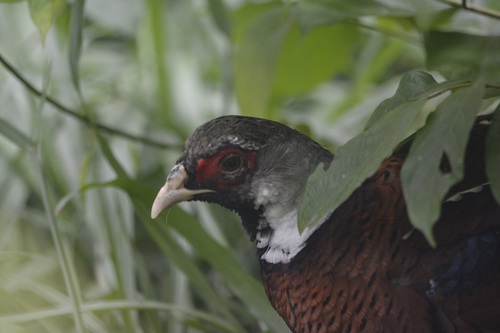 Elliot's PheasantSyrmaticus elliotiMales are up to 80 cm (31 in) long; they are brown and white with a black throat, chestnut-brown upper parts, white belly, nape and wing bars, red bare facial skin and long rusty-barred whitish tail.
 Reeves's PheasantSyrmaticus reevesiiMales measure 210 cm (83 in) long and weigh 1,529 g (3.371 lb).
Learn the Mrs. Hume's Pheasant in the BeakBrain App
Photo and call practice. Coming soon to iPhone and Android.
Play today's Daily BirdEvery photo and recording on this page is credited to its author under the licence shown. Spotted a problem with this page, or have a better photo? Contribute.