Learn what every symbol on the card means.Full credits and sources at beakbrain.com/symbols
 ForestGround nestLarge · 1.1 kg


ID tip
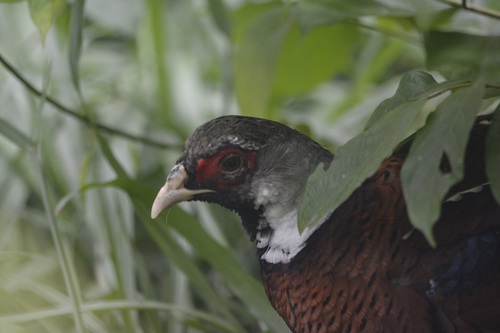
It is a large pheasant with a rich coppery chestnut plumage, yellowish bill, brown iris, and red facial skin. The female is a brown bird with greyish brown upperparts and buff barred dark brown below. The male has short spurs on its grey legs, while the female has none. Males are between 87.5 centimetres (34.4 in) and 136 centimetres (54 in) long, including the tail, while the female is between 51 centimetres (20 in) and 54 centimetres (21 in) (subspecies scintillating copper pheasant, scintillans). Juveniles have similar plumage to the females.
Text from Wikipedia, licensed CC BY-SA 4.0.
When to see the Copper Pheasant
One bar for each month. Filled bars are the 11 months with records; pale bars are months with none. The wide bar is May, the month with the most records.
Where to see the Copper Pheasant
The map shades 1 country with regular records. Everything unshaded has no records. Countries are listed below the map.
About the Copper Pheasant
The copper pheasant, also known as Soemmerring's pheasant or yamadori (ヤマドリ), is a pheasant endemic to the Japanese archipelago. The scientific name commemorates the German scientist Samuel Thomas von Sömmerring. It is the official bird of multiple Japanese prefectures, cities, and towns. It was commonly hunted for sport throughout the 20th century.
Text adapted from Wikipedia, licensed CC BY-SA 4.0.
Easily confused with
 Elliot's PheasantSyrmaticus elliotiMales are up to 80 cm (31 in) long; they are brown and white with a black throat, chestnut-brown upper parts, white belly, nape and wing bars, red bare facial skin and long rusty-barred whitish tail.
 Mrs. Hume's PheasantSyrmaticus humiaeThe pheasant is up to 90 cm (35 in) long with a greyish brown head, bare red facial skin, chestnut brown plumage, yellowish bill, brownish orange iris, white wingbars and metallic blue neck feathers.
 Reeves's PheasantSyrmaticus reevesiiMales measure 210 cm (83 in) long and weigh 1,529 g (3.371 lb).
Learn the Copper Pheasant in the BeakBrain App
Photo and call practice. Coming soon to iPhone and Android.
Play today's Daily BirdEvery photo and recording on this page is credited to its author under the licence shown. Spotted a problem with this page, or have a better photo? Contribute.