Learn what every symbol on the card means.Full credits and sources at beakbrain.com/symbols
 GrasslandCup nestSmall · 21 g


What the Meadow Bunting sounds like

ID tip
The meadow bunting is 15 to 16.5 cm long. The male is mostly rufous-brown with dark streaks on the back. The boldly-patterned head is brown with white eyebrows, moustachial stripe and throat and grey sides to the neck. The outer tail-feathers are white and the legs are pinkish-brown. Females are similar but are duller and paler with a less well-defined head pattern. The song is a short, hurried phrase given from a prominent perch. The call is a series of up to four sharp notes. It breeds in southern Siberia, northern and eastern China, eastern Kazakhstan, Kyrgyzstan, Mongolia, Korea and Japan.
Text from Wikipedia, licensed CC BY-SA 4.0.
When to see the Meadow Bunting
One bar for each month. Filled bars are the 10 months with records; pale bars are months with none. The wide bar is May, the month with the most records.
Where to see the Meadow Bunting
The map shades 8 countries with regular records, and 3 more in a lighter tone where the bird turns up only as a stray. Everything unshaded has no records. Countries are listed below the map.
Recorded as a rare visitor in Taiwan, United Kingdom, Sweden.
About the Meadow Bunting
The meadow bunting or Siberian meadow bunting is a passerine bird of eastern Asia which belongs to the genus Emberiza in the bunting family Emberizidae.
Text adapted from Wikipedia, licensed CC BY-SA 4.0.
Easily confused with
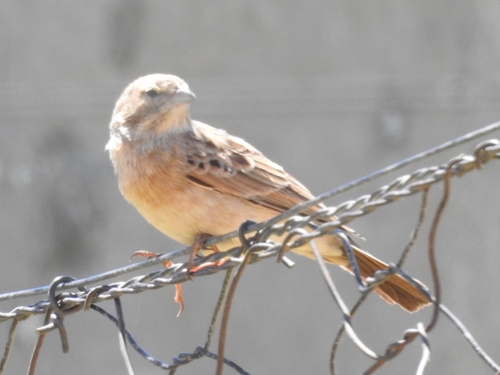 Lark-like BuntingEmberiza impetuaniThe lark-like bunting is a species of bird in the family Emberizidae, which is native to south-western Africa.
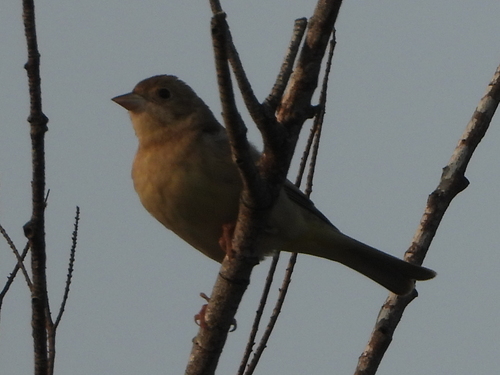 Black-headed BuntingEmberiza melanocephalaThis bird is 15 cm (5.9 in) long, larger than a reed bunting, and with a long-tail.
 Yellow-throated BuntingEmberiza elegansThe yellow-throated bunting, also known as the elegant bunting, is a species of bird in the family Emberizidae.
Side by side: Black-headed Bunting vs Meadow Bunting
Learn the Meadow Bunting in the BeakBrain App
Photo and call practice. Coming soon to iPhone and Android.
Play today's Daily BirdEvery photo and recording on this page is credited to its author under the licence shown. Spotted a problem with this page, or have a better photo? Contribute.