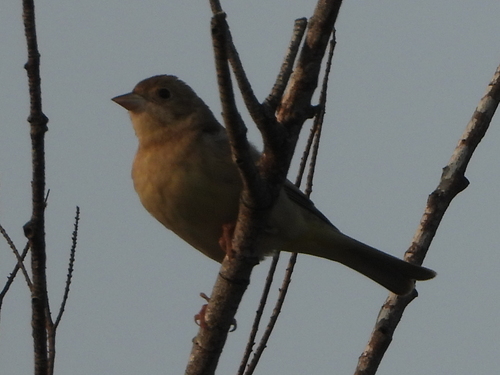
Black-headed Bunting
Emberiza melanocephala
This bird is 15 cm (5.9 in) long, larger than a reed bunting, and with a long-tail. The breeding male has bright yellow underparts, chestnut upperparts and a black hood. The female is a washed-out version of the male, with paler underparts, a grey-brown back and a greyish head. The juvenile is similar but the vent is yellow, and both can be difficult to separate from the corresponding plumages of the closely related red-headed bunting although the black-headed tends to have the cheeks darker than the throat. First year males have a grey crown and the back has patches of chestnut and grey.
ID text from Wikipedia, CC BY-SA 4.0


Meadow Bunting
Emberiza cioides
The meadow bunting is 15 to 16.5 cm long. The male is mostly rufous-brown with dark streaks on the back. The boldly-patterned head is brown with white eyebrows, moustachial stripe and throat and grey sides to the neck. The outer tail-feathers are white and the legs are pinkish-brown. Females are similar but are duller and paler with a less well-defined head pattern. The song is a short, hurried phrase given from a prominent perch. The call is a series of up to four sharp notes. It breeds in southern Siberia, northern and eastern China, eastern Kazakhstan, Kyrgyzstan, Mongolia, Korea and Japan.
ID text from Wikipedia, CC BY-SA 4.0

Where you might meet both
Learn this pair in the BeakBrain App
Photo and call practice. Coming soon to iPhone and Android.
Play today's Daily BirdPhotos and recordings are credited to their authors under the licence shown. Full profiles: Black-headed Bunting and Meadow Bunting.