Learn what every symbol on the card means.Full credits and sources at beakbrain.com/symbols
 WetlandScrapeMedium · 104 g







ID tip
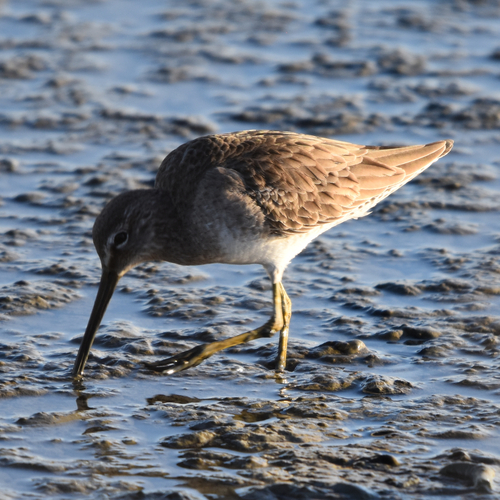
The long-billed dowitcher is a medium-sized, stocky sandpiper with a bill about twice the length of its head. In all plumages, the long-billed dowitcher has a whitish supercilium and dark loral stripe that continuous past the eye. The tail is barred black and white with the black being almost twice the width of the white and a large distinctive white rump which extends up to the middle of its back. Long-billed dowitcher are in breeding plumage from approximately May to late August or early September. Voice: The long-billed dowitcher's main call, mostly heard in flight but also while on ground, is a high, sharp keek sometimes repeated as an accelerating quick double or triple note series. Its second, less common call is a tu given 1-8 times. Its song is described as pee-witch-er, and its alarm call is an explosive KEEK.
Text from Wikipedia, licensed CC BY-SA 4.0.
When to see the Long-billed Dowitcher
One bar for each month. Filled bars are the 11 months with records; pale bars are months with none. The wide bar is April, the month with the most records.
Where to see the Long-billed Dowitcher
The map shades 54 countries with regular records, and 14 more in a lighter tone where the bird turns up only as a stray. Everything unshaded has no records. Countries are listed below the map.
Recorded as a rare visitor in India, Australia, Belgium, Finland, Venezuela, Morocco, Ukraine, French Guiana, St. Martin, Guam, Martinique, Turks & Caicos Islands, Cambodia, United Arab Emirates.
About the Long-billed Dowitcher
The long-billed dowitcher is a medium-sized shorebird with a relatively long bill belonging to the sandpiper family, Scolopacidae. In breeding plumage, adults are characterized by a rufous head and underparts with a darker mottled back and a large white upper rump only seen in flight. They feed in various freshwater habitats with their bill underwater in a "sewing machine" motion and have a mating display where males chase females in flight. The genus, Limnodromus is Ancient Greek from limne, "marsh" and dromos, "racer". The specific scolopaceus is Neo-Latin for "snipe-like", from Latin scolopax, scolopacis, a snipe or woodcock.
Text adapted from Wikipedia, licensed CC BY-SA 4.0.
Easily confused with
 Short-billed DowitcherLimnodromus griseusAdults' bodies are dark brown on top and reddish underneath.
 Asian DowitcherLimnodromus semipalmatusAdults have dark legs and a long, straight dark bill, somewhat shorter than that of the long-billed dowitcher.
Side by side: Long-billed Dowitcher vs Short-billed Dowitcher · Asian Dowitcher vs Long-billed Dowitcher
Learn the Long-billed Dowitcher in the BeakBrain App
Photo and call practice. Coming soon to iPhone and Android.
Play today's Daily BirdEvery photo and recording on this page is credited to its author under the licence shown. Spotted a problem with this page, or have a better photo? Contribute.