Learn what every symbol on the card means.Full credits and sources at beakbrain.com/symbols
 WetlandScrapeMedium · 111 g

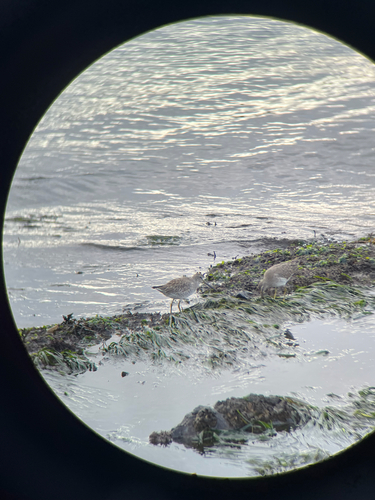
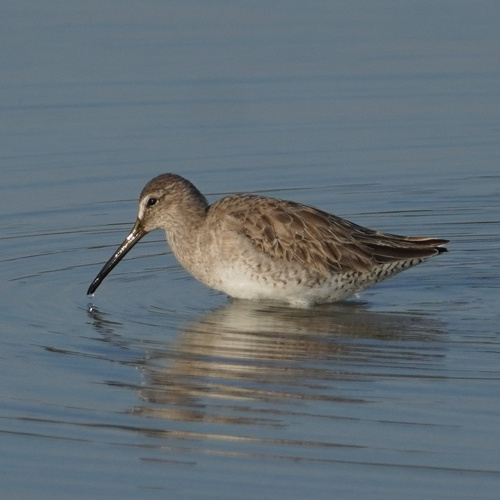
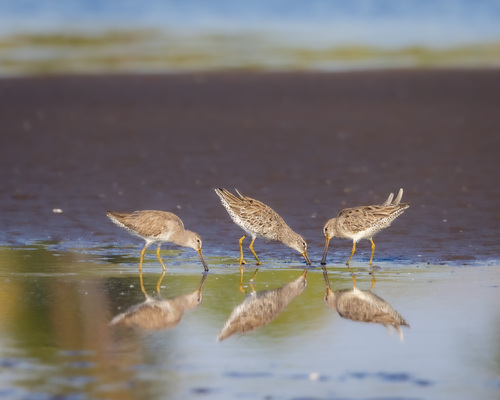
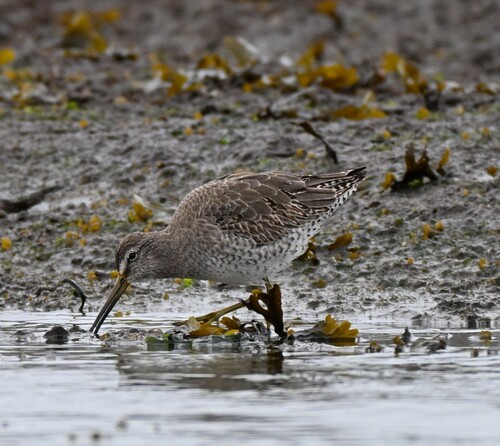
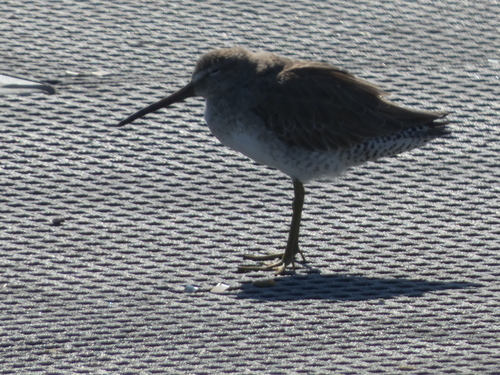
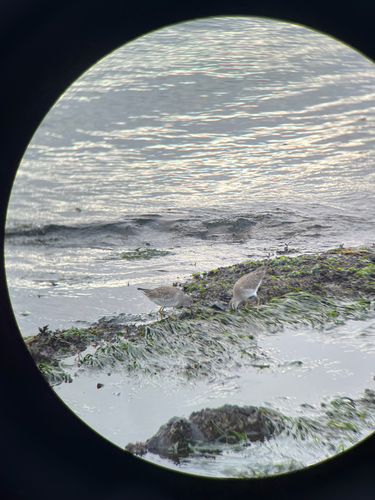
ID tip
Adults' bodies are dark brown on top and reddish underneath. The tail has a black-and-white barred pattern, and the legs are yellowish. The three subspecies have slight variations in appearance: Limnodromus griseus griseus has a white belly and barred flanks. Limnodromus griseus hendersoni has a reddish belly and spotted flanks. Limnodromus griseus caurinus has a white belly, heavily barred flanks, and a densely spotted breast. None of these combines the reddish belly and barred flanks of the breeding plumage of the long-billed dowitcher. The winter plumage is largely grey.
Text from Wikipedia, licensed CC BY-SA 4.0.
When to see the Short-billed Dowitcher
One bar for each month. Filled bars are the 6 months with records; pale bars are months with none. The wide bar is August, the month with the most records.
Where to see the Short-billed Dowitcher
The map shades 53 countries with regular records, and 8 more in a lighter tone where the bird turns up only as a stray. Everything unshaded has no records. Countries are listed below the map.
Recorded as a rare visitor in United Kingdom, Norway, France, Sweden, Taiwan, Iceland, Australia, Germany.
About the Short-billed Dowitcher
The short-billed dowitcher, like its congener, the long-billed dowitcher, is a medium-sized, stocky, long-billed shorebird in the family Scolopacidae.
Text adapted from Wikipedia, licensed CC BY-SA 4.0.
Easily confused with
 Long-billed DowitcherLimnodromus scolopaceusThe long-billed dowitcher is a medium-sized, stocky sandpiper with a bill about twice the length of its head.
 Asian DowitcherLimnodromus semipalmatusAdults have dark legs and a long, straight dark bill, somewhat shorter than that of the long-billed dowitcher.
Side by side: Long-billed Dowitcher vs Short-billed Dowitcher · Asian Dowitcher vs Short-billed Dowitcher
Learn the Short-billed Dowitcher in the BeakBrain App
Photo and call practice. Coming soon to iPhone and Android.
Play today's Daily BirdEvery photo and recording on this page is credited to its author under the licence shown. Spotted a problem with this page, or have a better photo? Contribute.