Learn what every symbol on the card means.Full credits and sources at beakbrain.com/symbols
 CoastalScrapeSmall · 57 g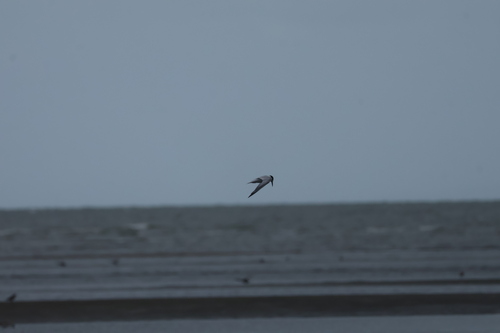







What the Little Tern sounds like


ID tip
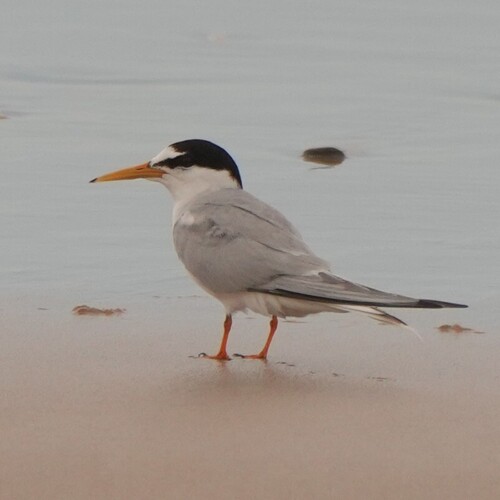
This is a small tern, 21–25 cm long with a 41–47 cm wingspan. It is not likely to be confused with other species, apart from fairy tern and Saunders's tern, because of its size and white forehead in breeding plumage. Its thin sharp bill is yellow with a black tip and its legs are also yellow. In winter, the forehead is more extensively white, the bill is black and the legs duller.
Text from Wikipedia, licensed CC BY-SA 4.0.
When to see the Little Tern
One bar for each month. Filled bars are the 8 months with records; pale bars are months with none. The wide bar is May, the month with the most records.
Where to see the Little Tern
The map shades 124 countries with regular records, and 6 more in a lighter tone where the bird turns up only as a stray. Everything unshaded has no records. Countries are listed below the map.
Recorded as a rare visitor in Iceland, Palestinian Territories, Kiribati, Benin, United States, Malta.
About the Little Tern
The little tern is a seabird of the family Laridae. It was first described by the German naturalist Peter Simon Pallas in 1764 and given the binomial name Sterna albifrons. It was moved to the genus Sternula when the genus Sterna was restricted to the larger typical terns. The genus name Sternula is a diminutive of Sterna, 'tern', while the specific name albifrons is from Latin albus, 'white', and frons, 'forehead'.
Text adapted from Wikipedia, licensed CC BY-SA 4.0.
Easily confused with
 Least TernSternula antillarumThe least tern is a species of tern that breeds in North America and locally in northern South America.
 Yellow-billed TernSternula superciliarisIt measures approximately 23–25 centimeters in body length and weighs 40–57 grams.
 Fairy TernSternula nereisThe fairy tern is a small tern with a white body and light bluish-grey wings.
Side by side: Little Gull vs Little Tern · Little Tern vs Yellow-billed Tern · Fairy Tern vs Little Tern
Learn the Little Tern in the BeakBrain App
Photo and call practice. Coming soon to iPhone and Android.
Play today's Daily BirdEvery photo and recording on this page is credited to its author under the licence shown. Spotted a problem with this page, or have a better photo? Contribute.