Learn what every symbol on the card means.Full credits and sources at beakbrain.com/symbols
 WetlandPlatform nestMedium · 169 g


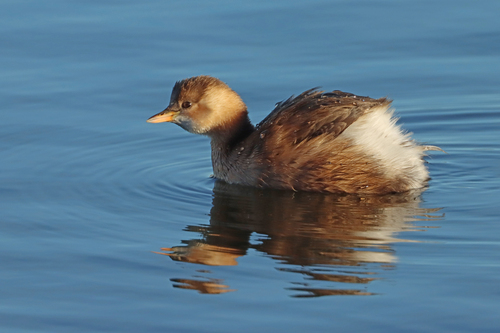
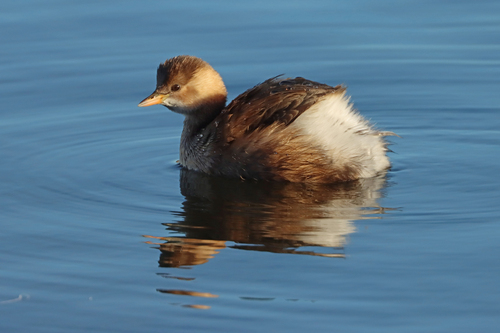
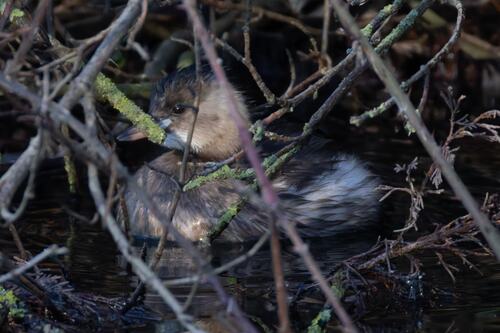


What the Little Grebe sounds like


ID tip
The little grebe is a small water bird with a pointed bill. The adult is unmistakable in summer, predominantly dark above with its rich, rufous colour neck, cheeks and flanks, and bright yellow gape. The rufous is replaced by a dirty brownish grey in non-breeding and juvenile birds. Juvenile birds have a yellow bill with a small black tip, and black and white streaks on the cheeks and sides of the neck as seen below. This yellow bill darkens as the juveniles age, eventually turning black in adulthood.
Text from Wikipedia, licensed CC BY-SA 4.0.
When to see the Little Grebe
One bar for each month, and every month is filled: this bird is recorded here in all twelve. The wide bar is January, the month with the most records.
Where to see the Little Grebe
The map shades 140 countries with regular records, and 3 more in a lighter tone where the bird turns up only as a stray. Everything unshaded has no records. Countries are listed below the map.
Recorded as a rare visitor in Australia, Niger, Central African Republic.
About the Little Grebe
The little grebe, also known as the dabchick, is a member of the grebe family of water birds. The genus name is from Ancient Greek takhus "fast" and bapto "to sink under". The specific ruficollis is from Latin rufus "red" and Modern Latin -collis, "-necked", itself derived from Latin collum "neck".
Text adapted from Wikipedia, licensed CC BY-SA 4.0.
Easily confused with
 Australasian GrebeTachybaptus novaehollandiaeThe Australasian grebe is a small waterbird common on fresh water lakes and rivers in greater Australia, New Zealand and on nearby Pacific islands.
 Least GrebeTachybaptus dominicusThe least grebe ranges in length from 21–27 cm (8.3–10.6 in) (depending on the subspecies) and in weight from 112–180 g (4.0–6.3 oz).
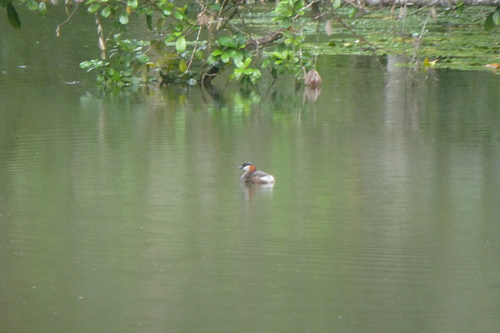 Madagascar GrebeTachybaptus pelzelniiThe Madagascar grebe is around 25 cm long.
Side by side: Little Grebe vs Pied-billed Grebe · Least Grebe vs Little Grebe
Learn the Little Grebe in the BeakBrain App
Photo and call practice. Coming soon to iPhone and Android.
Play today's Daily BirdEvery photo and recording on this page is credited to its author under the licence shown. Spotted a problem with this page, or have a better photo? Contribute.