Learn what every symbol on the card means.Full credits and sources at beakbrain.com/symbols
 GrasslandPlatform nestHuge · 1.8 kg


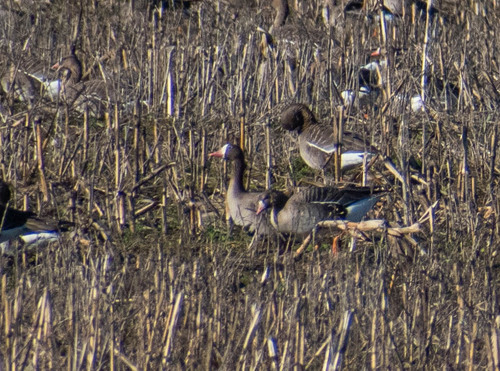
ID tip
The two white-fronted goose species differ little other than in size (the lesser, at 53–66 cm (21–26 in) length and with a 120–135 cm (47–53 in) wingspan, is not much bigger than a mallard (Anas platyrhynchos)), but both may be readily distinguished from the greylag goose by their bright orange legs and their mouse-coloured upper wing-coverts. The greylag goose has a flesh-coloured bill and legs and the upper wing-coverts are bluish-grey. Both white-fronted goose species have a very conspicuous white face and broad black bars which cross the belly.
Text from Wikipedia, licensed CC BY-SA 4.0.
When to see the Lesser White-fronted Goose
One bar for each month. Filled bars are the 9 months with records; pale bars are months with none. The wide bar is April, the month with the most records.
Where to see the Lesser White-fronted Goose
The map shades 40 countries with regular records, and 7 more in a lighter tone where the bird turns up only as a stray. Everything unshaded has no records. Countries are listed below the map.
Recorded as a rare visitor in France, Spain, Finland, Portugal, United States, Ireland, Switzerland.
About the Lesser White-fronted Goose
The lesser white-fronted goose is a goose closely related to the larger greater white-fronted goose. It breeds in the northernmost Palearctic, but it is a scarce breeder in Europe, with a reintroduction attempt in Fennoscandia.
Text adapted from Wikipedia, licensed CC BY-SA 4.0.
Easily confused with
 Swan GooseAnser cygnoidesThe swan goose is large and long-necked for its genus, wild birds being 81–94 cm (32–37 in) long (the longest Anser goose) and weighing 2.8–3.5 kg (6.2–7.7 lb) or more (the second-heaviest Anser, after the greylag goose A. anser).
 Emperor GooseAnser canagicusThe emperor goose has a stout blue-gray body, with spots of black and white, which cause it to have a "scaled appearance".
 Bar-headed GooseAnser indicusThe bird is pale grey and is easily distinguished from any of the other grey geese of the genus Anser by the black bars on its otherwise white head.
Side by side: Emperor Goose vs Lesser White-fronted Goose · Lesser White-fronted Goose vs Swan Goose · Bar-headed Goose vs Lesser White-fronted Goose
Learn the Lesser White-fronted Goose in the BeakBrain App
Photo and call practice. Coming soon to iPhone and Android.
Play today's Daily BirdEvery photo and recording on this page is credited to its author under the licence shown. Spotted a problem with this page, or have a better photo? Contribute.