Learn what every symbol on the card means.Full credits and sources at beakbrain.com/symbols
 CoastalPlatform nestHuge · 2.1 kg


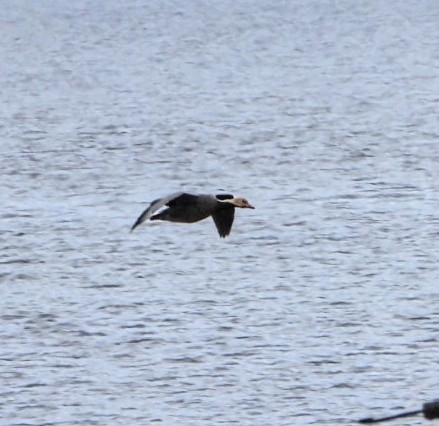


ID tip
The emperor goose has a stout blue-gray body, with spots of black and white, which cause it to have a "scaled appearance". Its head and the back of its neck are white and tinged with amber-yellow; unlike the snow goose, the white does not extend to the front of the neck. The goose is also characterized by a black chin and throat, a white tail, a pink bill, which is tipped with white, and yellow-orange legs and feet. The underside of the emperor goose's wings is gray, unlike the snow goose, which has black and white on the underside of its wings. Voice: Its vocalizations, according to Edward William Nelson, sound like "kla-ha, kla-ha, kla-ha", and can be differentiated from those of other geese by having a more "nasal" sound. It vocalizes less often than other geese, such as the white-fronted goose.
Text from Wikipedia, licensed CC BY-SA 4.0.
When to see the Emperor Goose
One bar for each month. Filled bars are the 11 months with records; pale bars are months with none. The wide bar is June, the month with the most records.
Where to see the Emperor Goose
The map shades 4 countries with regular records, and 11 more in a lighter tone where the bird turns up only as a stray. Everything unshaded has no records. Countries are listed below the map.
Recorded as a rare visitor in Sweden, United Kingdom, Canada, Belgium, Germany, Netherlands, Portugal, Norway, Poland, Iceland, France.
About the Emperor Goose
The emperor goose, also known as the beach goose or the painted goose, is a waterfowl species in the family Anatidae, which contains the ducks, geese, and swans. In summer, the emperor goose is found in remote coastal areas near the Bering Sea in arctic and sub-arctic Alaska and the Russian Far East, where it breeds in monogamous pairs. It migrates south to winter in ice-free mudflats and coasts in Alaska, mostly the Aleutian Islands, and Canada's British Columbia, rarely reaching the contiguous United States. Listed as near threatened by the International Union for Conservation of Nature, the species' population is declining due to threats such as pollution, hunting, and climate change.
Text adapted from Wikipedia, licensed CC BY-SA 4.0.
Easily confused with
 Swan GooseAnser cygnoidesThe swan goose is large and long-necked for its genus, wild birds being 81–94 cm (32–37 in) long (the longest Anser goose) and weighing 2.8–3.5 kg (6.2–7.7 lb) or more (the second-heaviest Anser, after the greylag goose A. anser).
 Lesser White-fronted GooseAnser erythropusThe two white-fronted goose species differ little other than in size (the lesser, at 53–66 cm (21–26 in) length and with a 120–135 cm (47–53 in) wingspan, is not much bigger than a mallard (Anas platyrhynchos)), but both may be readily distinguished from the greylag goose by their bright orange legs and their mouse-coloured upper wing-coverts.
 Bar-headed GooseAnser indicusThe bird is pale grey and is easily distinguished from any of the other grey geese of the genus Anser by the black bars on its otherwise white head.
Side by side: Emperor Goose vs Tundra Bean Goose · Emperor Goose vs Taiga Bean Goose · Bar-headed Goose vs Emperor Goose · Emperor Goose vs Swan Goose · Emperor Goose vs Lesser White-fronted Goose
Learn the Emperor Goose in the BeakBrain App
Photo and call practice. Coming soon to iPhone and Android.
Play today's Daily BirdEvery photo and recording on this page is credited to its author under the licence shown. Spotted a problem with this page, or have a better photo? Contribute.