Learn what every symbol on the card means.Full credits and sources at beakbrain.com/symbols
 GrasslandScrapeLarge · 614 g


ID tip
A male in breeding plumage has a black head, neck and lower parts. However, his throat is white. Around three 4-inch (10 cm) long, ribbon-like feathers arise from behind the ear-coverts on each side of the head and extend backwards, curving up and ending in spatulate tip. The back and scapulars are mottled in white with V-shaped marks. The wing coverts are white. After the breedings season, the male tends to have some white in the wing. The female is slightly larger than the male.
Text from Wikipedia, licensed CC BY-SA 4.0.
When to see the Lesser Florican
One bar for each month. Filled bars are the 5 months with records; pale bars are months with none. The wide bar is April, the month with the most records.
About the Lesser Florican
The lesser florican, also known as the likh or kharmore, is the smallest in the bustard family and the only member of the genus Sypheotides. It is endemic to the Indian Subcontinent where it is found in tall grasslands and is best known for the leaping breeding displays made by the males during the monsoon season. The male has a contrasting black and white breeding plumage and distinctive elongated head feathers that extend behind the neck. These bustards are found mainly in northwestern and central India during the summer but are found more widely distributed across India in winter. The species is highly endangered and has been extirpated in some parts of its range such as Pakistan.
Text adapted from Wikipedia, licensed CC BY-SA 4.0.
Easily confused with
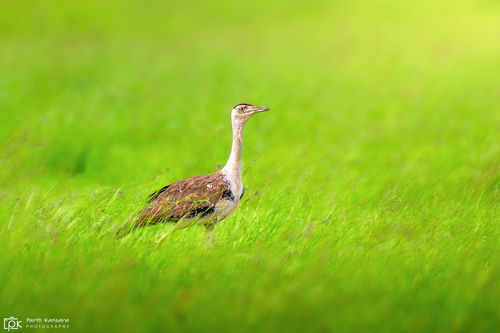 Great Indian BustardArdeotis nigricepsThe great Indian bustard is a large ground bird with a height of about one metre.
Little Brown BustardHeterotetrax humilisThe smallest species in its genus, the little brown bustard reaches a maximum length of about 45 cm (18 in).
Great Indian BustardArdeotis nigricepsThe great Indian bustard is a large ground bird with a height of about one metre.
Little Brown BustardHeterotetrax humilisThe smallest species in its genus, the little brown bustard reaches a maximum length of about 45 cm (18 in).
 Nubian BustardNeotis nubaThe Nubian bustard is medium-large with pronounced sexual size dimorphism.
Learn the Lesser Florican in the BeakBrain App
Photo and call practice. Coming soon to iPhone and Android.
Play today's Daily BirdEvery photo and recording on this page is credited to its author under the licence shown. Spotted a problem with this page, or have a better photo? Contribute.