Learn what every symbol on the card means.Full credits and sources at beakbrain.com/symbols
 GrasslandScrapeLarge · 698 g
ID tip
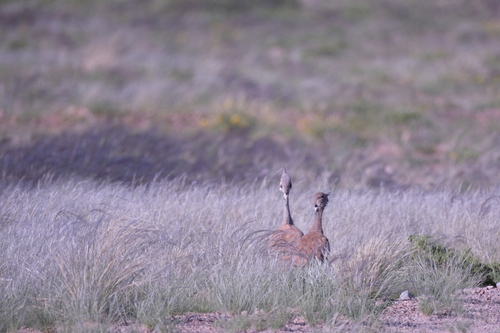
The smallest species in its genus, the little brown bustard reaches a maximum length of about 45 cm (18 in). They are light brown birds with whitish underparts, long necks and legs, relatively short bills, powder-down and photoreactive porphyrins at the base of feathers, no uropygial gland, no hind toe and nidifugous young. The male has a black tuft on the nape, and a black throat speckled with white. The female lacks these black areas, instead having heavy buff spotting on the back, wings and breast.
Text from Wikipedia, licensed CC BY-SA 4.0.
When to see the Little Brown Bustard
One bar for each month. Filled bars are the 5 months with records; pale bars are months with none. The wide bar is January, the month with the most records.
Where to see the Little Brown Bustard
The map shades 1 country with regular records. Everything unshaded has no records. Countries are listed below the map.
About the Little Brown Bustard
The little brown bustard is a species of bird in the family Otididae. Found in Ethiopia and Somalia, its natural habitats are subtropical or tropical dry shrubland and subtropical or tropical dry lowland grassland. As indicated by its name, this bustard is the world's smallest at 45 cm (18 in) and 600 grams (1.3 lb). It is threatened by habitat destruction.
Text adapted from Wikipedia, licensed CC BY-SA 4.0.
Easily confused with

Learn the Little Brown Bustard in the BeakBrain App
Photo and call practice. Coming soon to iPhone and Android.
Play today's Daily BirdEvery photo and recording on this page is credited to its author under the licence shown. Spotted a problem with this page, or have a better photo? Contribute.