Learn what every symbol on the card means.Full credits and sources at beakbrain.com/symbols
 CoastalPlatform nestLarge · 762 g


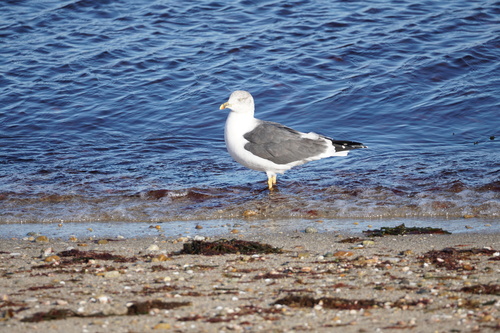

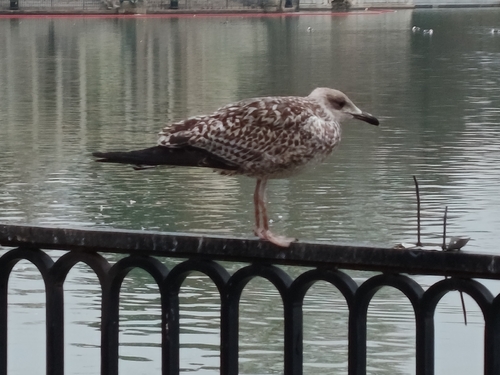

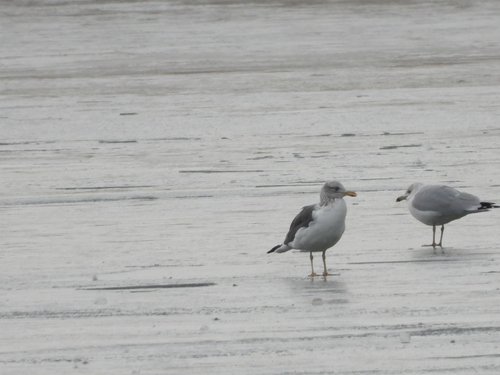
What the Lesser Black-backed Gull sounds like


ID tip
The lesser black-backed gull is smaller than the European herring gull. The taxonomy of the herring gull / lesser black-backed gull complex is complicated; different authorities recognise between two and eight species. This group has a ring species distribution around the Northern Hemisphere. Differences between adjacent forms in this ring are fairly small, but by the time the circuit is completed, the end members, herring gull and lesser black-backed gull, are clearly different species.
Text from Wikipedia, licensed CC BY-SA 4.0.
When to see the Lesser Black-backed Gull
One bar for each month, and every month is filled: this bird is recorded here in all twelve. The wide bar is July, the month with the most records.
Where to see the Lesser Black-backed Gull
The map shades 159 countries with regular records, and 13 more in a lighter tone where the bird turns up only as a stray. Everything unshaded has no records. Countries are listed below the map.
Recorded as a rare visitor in Australia, Luxembourg, Ecuador, Mali, Seychelles, El Salvador, St. Barthélemy, U.S. Virgin Islands, Benin, Guinea-Bissau, Malawi, Mayotte, Brazil.
About the Lesser Black-backed Gull
The lesser black-backed gull is a large gull that breeds on the Atlantic and Arctic coasts of Europe. It is migratory, wintering from the British Isles south to West Africa. However, it has increased dramatically in North America, especially along the east coast. Formerly just a winter visitor to North America, it now occurs in large numbers some winters and birds are recorded year-round. However, there is serious concern about decline in many parts of its range. The species is on the UK Amber List because the UK is home to 40 per cent of the European population and more than half of these are found at fewer than ten breeding sites.
Text adapted from Wikipedia, licensed CC BY-SA 4.0.
Easily confused with
 European Herring GullLarus argentatusThe male European herring gull is 60–67 cm (24–26 in) long and weighs 1,050–1,525 g (2.315–3.362 lb), while the female is 55–62 cm (22–24 in) and weighs 710–1,100 g (1.57–2.43 lb).
 American Herring GullLarus smithsonianusThe herring gull is a heavily built large gull with a long powerful bill, full chest and sloping forehead.
 Great Black-backed GullLarus marinusThis is the largest gull in the world, considerably larger than a herring gull (Larus argentatus); only two other gulls, glaucous gull (Larus hyperboreus) and Pallas's gull (Ichthyaetus ichthyaetus), come close to matching this species in size.
Side by side: Lesser Black-backed Gull vs Ring-billed Gull · American Herring Gull vs Lesser Black-backed Gull · European Herring Gull vs Lesser Black-backed Gull · Great Black-backed Gull vs Lesser Black-backed Gull
Learn the Lesser Black-backed Gull in the BeakBrain App
Photo and call practice. Coming soon to iPhone and Android.
Play today's Daily BirdEvery photo and recording on this page is credited to its author under the licence shown. Spotted a problem with this page, or have a better photo? Contribute.