Learn what every symbol on the card means.Full credits and sources at beakbrain.com/symbols
 WoodlandDomed nestTiny · 8 g


ID tip
The inland thornbill is very similar to the brown thornbill (A. pusilla) in appearance, and these two species are sometimes considered conspecific. The brown thornbill is slightly smaller than the inland thornbill at approximately 10 cm (3.9 in) compared to 11.5 cm (4.5 in). The inland thornbill has white speckling on the forehead, while the brown thornbill has rufous speckling and is less grey than the inland thornbill. Range and habitat is the easiest way to differentiate these two species.
Text from Wikipedia, licensed CC BY-SA 4.0.
When to see the Inland Thornbill
One bar for each month, and every month is filled: this bird is recorded here in all twelve. The wide bar is October, the month with the most records.
Where to see the Inland Thornbill
The map shades 1 country with regular records. Everything unshaded has no records. Countries are listed below the map.
About the Inland Thornbill
The inland thornbill was originally described by English ornithologist John Gould in The Birds of Australia. Inland thornbills are within the order passerines. The inland thornbill belongs to the genus Acanthiza, which now has three more species than the eleven outlined by Gould in The Birds of Australia. The Noongar people of southwestern Western Australia call A. apicalis "Djoobi-Djoolbang". The inland thornbill is also known as the broad-tail thornbill and presently contains several subspecies that were once considered independent species. The word apicalis comes from the Latin for 'tipped'.
Text adapted from Wikipedia, licensed CC BY-SA 4.0.
Easily confused with
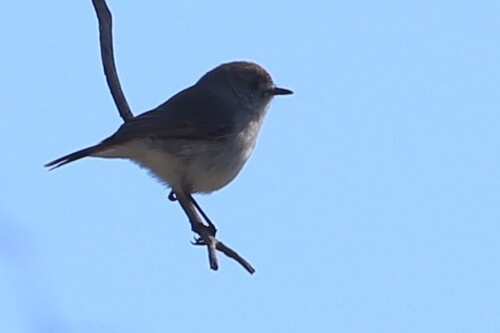 Chestnut-rumped ThornbillAcanthiza uropygialisLength: 9.8 cm (9-11); wing span 15.5 cm (14-16.5); weight: 6 g.
 Buff-rumped ThornbillAcanthiza reguloidesThe buff-rumped thornbill is a small passerine bird species belonging to the genus
Acanthiza, most of which are endemic to Australia.
Buff-rumped ThornbillAcanthiza reguloidesThe buff-rumped thornbill is a small passerine bird species belonging to the genus
Acanthiza, most of which are endemic to Australia.
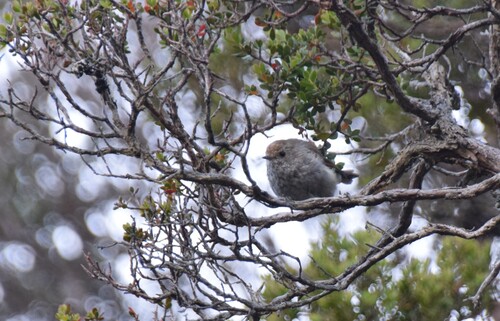 Tasmanian ThornbillAcanthiza ewingiiThe Tasmanian Thornbill is olive-brown above, darkening toward the back and tail, and can exhibit a patch of reddish-brown colouration on the forehead.
Side by side: Inland Thornbill vs Yellow Thornbill · Chestnut-rumped Thornbill vs Inland Thornbill · Inland Thornbill vs Tasmanian Thornbill
Learn the Inland Thornbill in the BeakBrain App
Photo and call practice. Coming soon to iPhone and Android.
Play today's Daily BirdEvery photo and recording on this page is credited to its author under the licence shown. Spotted a problem with this page, or have a better photo? Contribute.