Learn what every symbol on the card means.Full credits and sources at beakbrain.com/symbols
 UrbanCup nestMedium · 293 g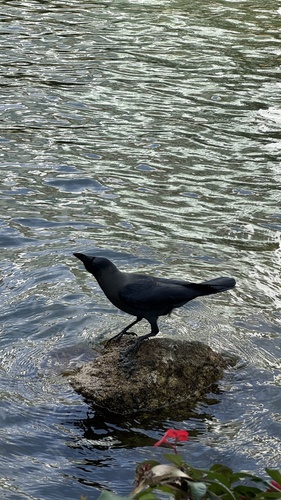
What the House Crow sounds like


ID tip
Voice: The voice of the house crow is harsh and usually represented by the onomatopoeia "kaaw-kaaw".
Text from Wikipedia, licensed CC BY-SA 4.0.
When to see the House Crow
One bar for each month, and every month is filled: this bird is recorded here in all twelve. The wide bar is February, the month with the most records.
Where to see the House Crow
The map shades 43 countries with regular records, and 10 more in a lighter tone where the bird turns up only as a stray. Everything unshaded has no records. Countries are listed below the map.
Recorded as a rare visitor in United States, Australia, Netherlands, Ireland, Brazil, Argentina, Cuba, Spain, France, Curaçao.
About the House Crow
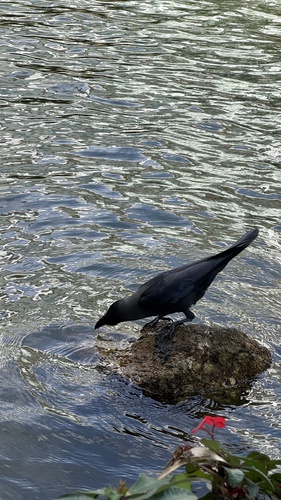
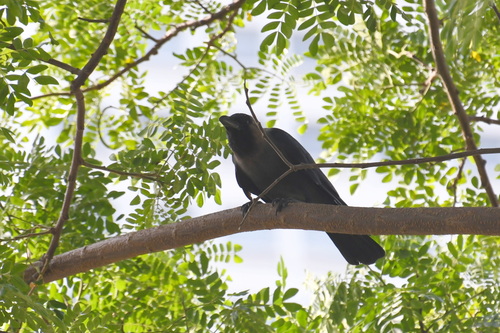
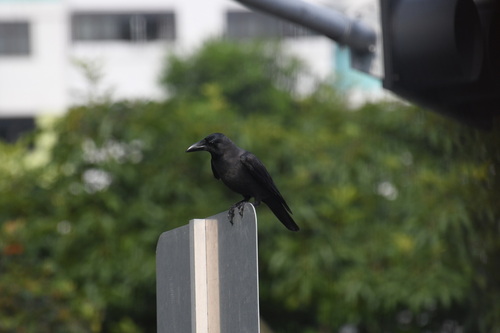
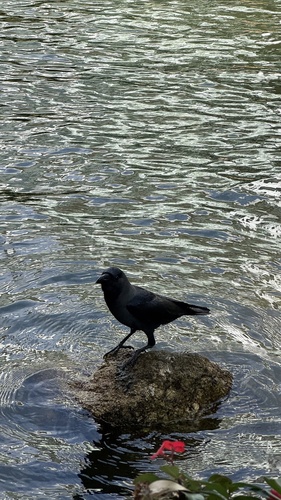
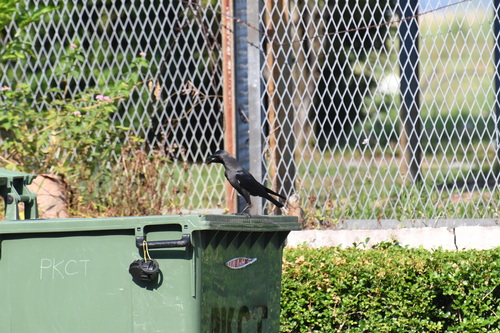
The house crow, also known as the Indian, greynecked, Ceylon or Colombo crow, is a common bird of the crow family that is of Asian origin but now found in many parts of the world, where they arrived assisted by shipping. It is between the jackdaw and the carrion crow in size but is slimmer than either. The forehead, crown, throat and upper breast are a richly glossed black, whilst the neck and breast are a lighter grey-brown in colour. The wings, tail and legs are black. There are regional variations in the thickness of the bill and the depth of colour in areas of the plumage.
Text adapted from Wikipedia, licensed CC BY-SA 4.0.
Easily confused with
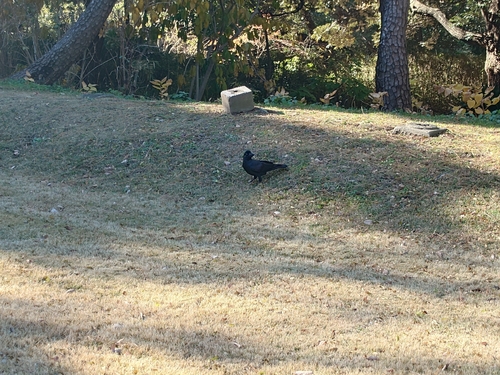 Large-billed CrowCorvus macrorhynchosThe large-billed crow is relatively large all-black corvid.
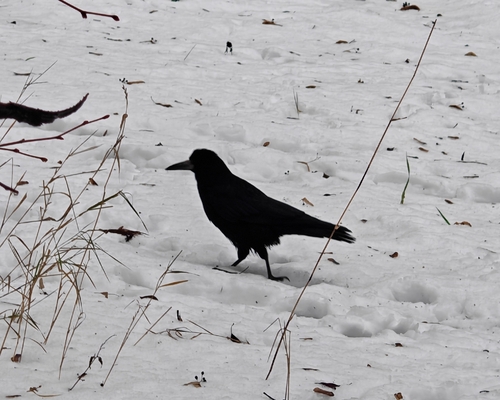 RookCorvus frugilegusThe rook is a fairly large bird, at 280 to 340 g (9.9 to 12.0 oz) adult weight, 44 to 46 cm (17 to 18 in) in length and 81 to 99 cm (32 to 39 in) wingspan.
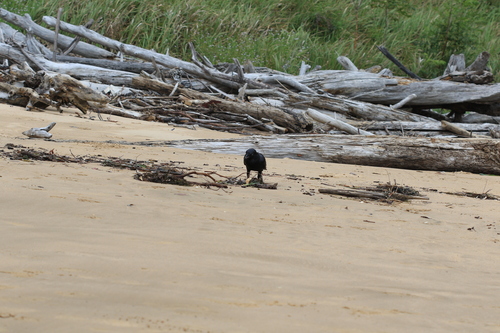 Australian RavenCorvus coronoidesMeasuring 46–53 cm (18–21 in) in length with a 100 cm (39 in) wingspan and weighing around the 650 g (1+7⁄16 lb), the Australian raven is Australia's largest species of corvid.
Side by side: Carrion Crow vs House Crow · Fish Crow vs House Crow · House Crow vs Large-billed Crow · House Crow vs Rook · Australian Raven vs House Crow
Learn the House Crow in the BeakBrain App
Photo and call practice. Coming soon to iPhone and Android.
Play today's Daily BirdEvery photo and recording on this page is credited to its author under the licence shown. Spotted a problem with this page, or have a better photo? Contribute.