Learn what every symbol on the card means.Full credits and sources at beakbrain.com/symbols
 ForestDomed nestSmall · 36 g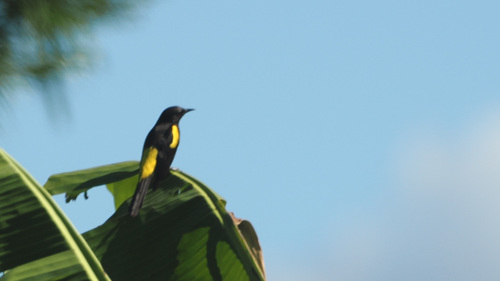
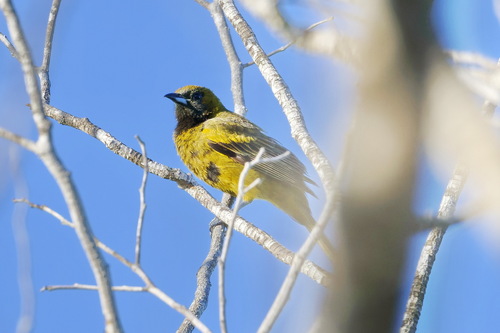
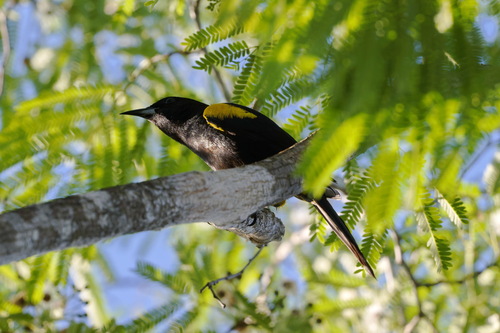
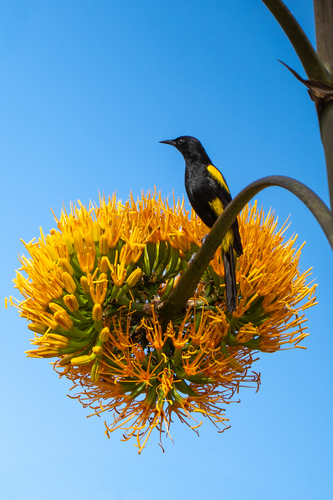


ID tip
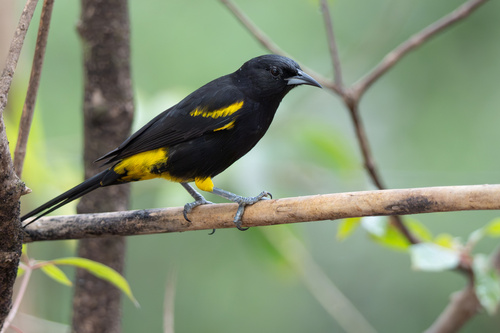
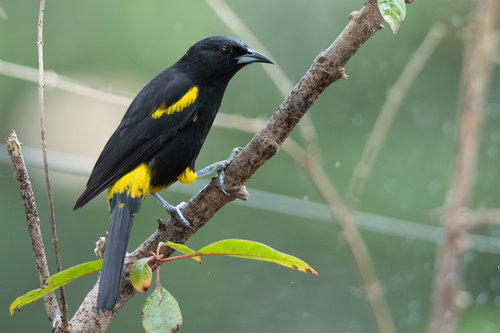
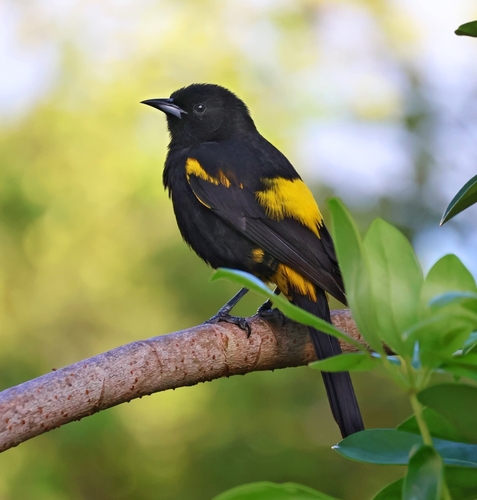
The Hispaniolan oriole is a slender-billed black and yellow oriole that lacks white markings on the wings. It shows more yellow than most Caribbean orioles, except for the Bahama oriole (Icterus northropi). The adult males and females are black overall, with distinctive yellow patches on shoulders, rump, and under-tail coverts extending to the lower breast. Like most tropical oriole species, the females are similar or identical to the males in coloring. In juvenile Hispaniolan orioles, the upper parts are mainly olive, while the underparts are dull yellow. Voice: The call of the Hispaniolan oriole is described as a sharp keck or check. The song is rarely heard, and is a series of high-pitched whistles. The song is usually given after dawn, but is almost never heard in the daytime, which is similar to the Puerto Rican oriole (Icterus portoricensis).
Text from Wikipedia, licensed CC BY-SA 4.0.
When to see the Hispaniolan Oriole
One bar for each month. Filled bars are the 8 months with records; pale bars are months with none. The wide bar is March, the month with the most records.
Where to see the Hispaniolan Oriole
The map shades 3 countries with regular records, and 2 more in a lighter tone where the bird turns up only as a stray. Everything unshaded has no records. Countries are listed below the map.
Recorded as a rare visitor in Mexico, Costa Rica.
About the Hispaniolan Oriole
The Hispaniolan oriole is a species of bird in the family Icteridae. It is endemic to the Caribbean island of Hispaniola.
Text adapted from Wikipedia, licensed CC BY-SA 4.0.
Easily confused with
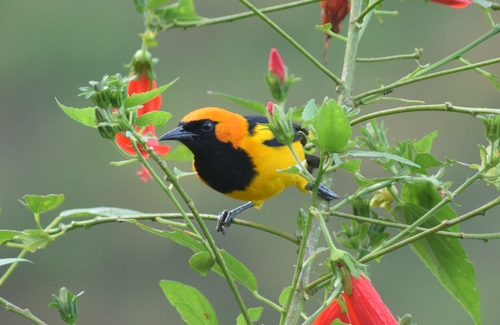 Orange-crowned OrioleIcterus auricapillusThe orange-crowned oriole is 18 to 20 cm (7.1 to 7.9 in) long.
 Jamaican OrioleIcterus leucopteryxThe Jamaican oriole is about 21 cm (8.3 in) long and weighs 34 to 42 g (1.2 to 1.5 oz).
 Black-backed OrioleIcterus abeilleiThe black-backed oriole is 18 to 20.5 cm (7.1 to 8.1 in) long and weighs 31 to 37 g (1.1 to 1.3 oz).
Side by side: Hispaniolan Oriole vs Orange-crowned Oriole · Black-backed Oriole vs Hispaniolan Oriole · Hispaniolan Oriole vs Jamaican Oriole
Learn the Hispaniolan Oriole in the BeakBrain App
Photo and call practice. Coming soon to iPhone and Android.
Play today's Daily BirdEvery photo and recording on this page is credited to its author under the licence shown. Spotted a problem with this page, or have a better photo? Contribute.