Learn what every symbol on the card means.Full credits and sources at beakbrain.com/symbols
 UrbanDomed nestSmall · 37 g


ID tip
The Jamaican oriole is about 21 cm (8.3 in) long and weighs 34 to 42 g (1.2 to 1.5 oz). The sexes have the same plumage though females are somewhat duller than males. Adults of the nominate subspecies are mostly olivaceous yellow with a somewhat yellower belly. They have a black mask, throat, and upper breast. Their wings are mostly black with wide white edges on the inner flight feathers and white coverts; the last show as a large white patch on the folded wing. Their tail is black. Subspecies I. l. lawrencii is a brighter yellow-green than the nominate and has lemon-yellow underparts. Voice: The Jamaican oriole's song is a "histled you cheat or cheat-you". Other renditions are tie-tiewu and tie-tiewu-tiewu. The species' calls are "a single or 2-note whistle a short chatter".
Text from Wikipedia, licensed CC BY-SA 4.0.
When to see the Jamaican Oriole
One bar for each month. Filled bars are the 7 months with records; pale bars are months with none. The wide bar is March, the month with the most records.
Where to see the Jamaican Oriole
The map shades 2 countries with regular records. Everything unshaded has no records. Countries are listed below the map.
About the Jamaican Oriole
The Jamaican oriole is a species of bird in the family Icteridae, the oropendolas, New World orioles, and New World blackbirds. It is found in Jamaica and on the Colombian island of San Andrés.
Text adapted from Wikipedia, licensed CC BY-SA 4.0.
Easily confused with
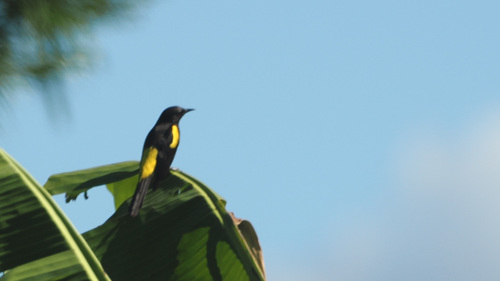 Hispaniolan OrioleIcterus dominicensisThe Hispaniolan oriole is a slender-billed black and yellow oriole that lacks white markings on the wings.
 White-edged OrioleIcterus graceannaeThe white-edged oriole is 19 to 20 cm (7.5 to 7.9 in) long.
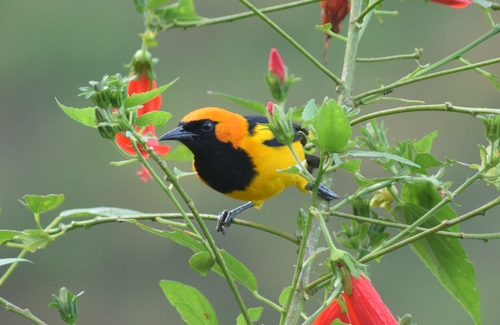 Orange-crowned OrioleIcterus auricapillusThe orange-crowned oriole is 18 to 20 cm (7.1 to 7.9 in) long.
Side by side: Hispaniolan Oriole vs Jamaican Oriole · Jamaican Oriole vs Orange-crowned Oriole · Jamaican Oriole vs White-edged Oriole
Learn the Jamaican Oriole in the BeakBrain App
Photo and call practice. Coming soon to iPhone and Android.
Play today's Daily BirdEvery photo and recording on this page is credited to its author under the licence shown. Spotted a problem with this page, or have a better photo? Contribute.