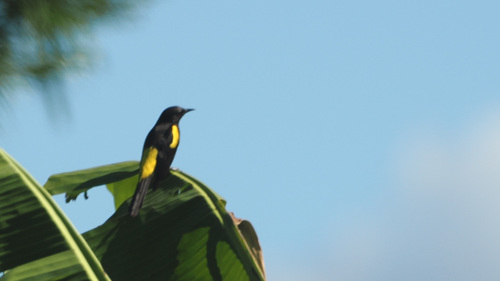
Hispaniolan Oriole
Icterus dominicensis
The Hispaniolan oriole is a slender-billed black and yellow oriole that lacks white markings on the wings. It shows more yellow than most Caribbean orioles, except for the Bahama oriole (Icterus northropi). The adult males and females are black overall, with distinctive yellow patches on shoulders, rump, and under-tail coverts extending to the lower breast. Like most tropical oriole species, the females are similar or identical to the males in coloring. In juvenile Hispaniolan orioles, the upper parts are mainly olive, while the underparts are dull yellow. Voice: The call of the Hispaniolan oriole is described as a sharp keck or check. The song is rarely heard, and is a series of high-pitched whistles. The song is usually given after dawn, but is almost never heard in the daytime, which is similar to the Puerto Rican oriole (Icterus portoricensis).
ID text from Wikipedia, CC BY-SA 4.0
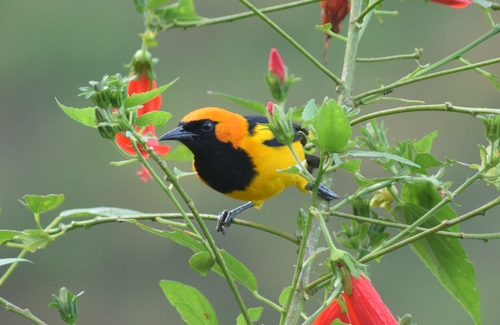
Orange-crowned Oriole
Icterus auricapillus
The orange-crowned oriole is 18 to 20 cm (7.1 to 7.9 in) long. Males weigh an average of about 33 g (1.2 oz) and females an average of 32 g (1.1 oz). The sexes have the same plumage. Adults have an orange-red crown, nape, and sides of the head. The rest of their face and their throat, breast, mantle, upper back, and tail are black. Their lower back and rump are yellow and their rearmost uppertail coverts are black with thin yellow edges at the end. Their wing is mostly black with yellow lesser and median coverts that show as an epaulet on the closed wing. Voice: The orange-crowned oriole's song is "a loud, musical, whistled werr, chéet-your-kurr" and it also makes "a musical but slower, longer, rambling ser". Its calls are "a burry and complaining wheea" sharp ze'e't". When foraging it sometimes makes "a loud, clear whistled krEEEa".
ID text from Wikipedia, CC BY-SA 4.0

Learn this pair in the BeakBrain App
Photo and call practice. Coming soon to iPhone and Android.
Play today's Daily BirdPhotos and recordings are credited to their authors under the licence shown. Full profiles: Hispaniolan Oriole and Orange-crowned Oriole.